- Category
- Water and Beginning Birds
- Domain
- Water, beginning of the world, cosmic egg, wedding songs, fertility, boundary between worlds
- Source status
- folkloric
little duck, water bird, duck egg, wild duck
What does the duck mean?
In Lithuanian folklore the duck is a water bird associated with the beginning of the world and the emergence of life. It lives on and near water, so it belongs to the primordial element from which myths often begin the making of the world.
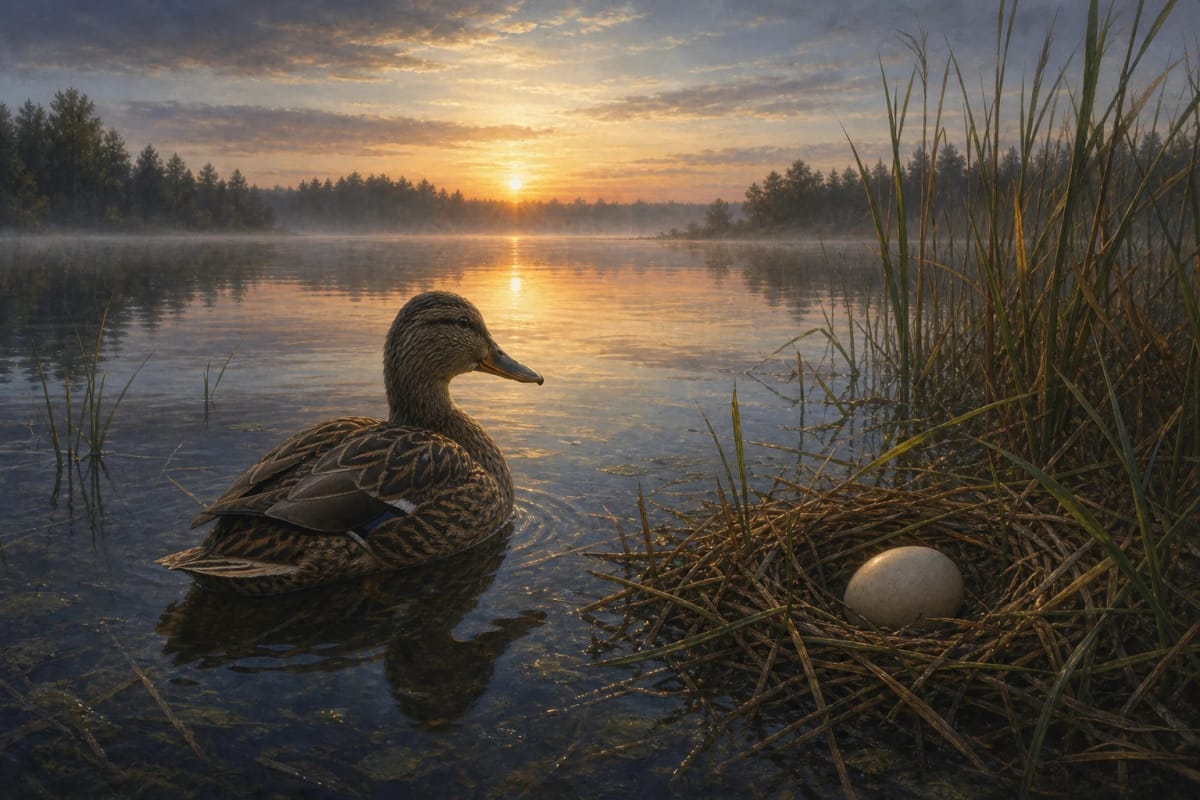
The duck's most important role is cosmogonic: in some Lithuanian legends it is the duck that lays the egg from which earth, water, and sky appear. For that reason the duck is not only a water bird, but also a bird of beginnings.
The duck and the creation of the world
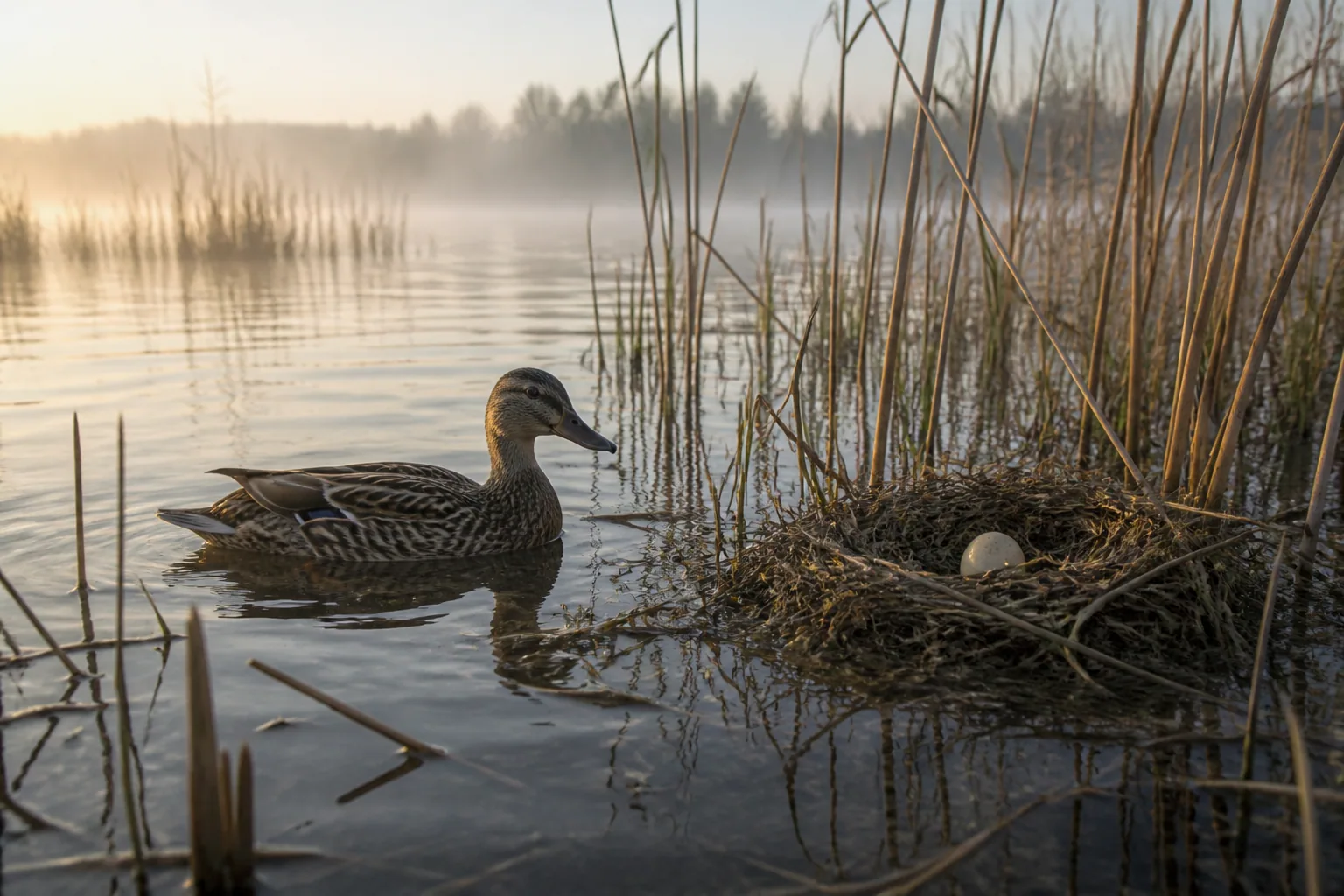
The most important Lithuanian testimony about the duck was recorded by Juozas Šliavas in Žeimelis. The tale says that a giant duck sat on a stone in the moon. It laid an egg and was preparing to hatch it, but then wanted to feed and flew off in search of food.
At that moment rain came, soaked and tore apart the nest, and the egg fell and broke. From its parts the world came into being. In this way the tale explains how earth, waters, and sky arose from the duck's egg.
The cosmic egg
The duck tale belongs to the wide image of the world egg, known in many mythologies: the world is imagined as an egg or as arising from one. The shell corresponds to the sky, the membrane to clouds, the white to water, and the yolk to earth.
In another Lithuanian version, God, wanting to separate heaven from earth, throws the duck's egg against a stone. The egg splits into three parts: from the yolk come earth and sun, from the white water and moon, and from the speckled shell the sky with stars.
The duck, the egg, and Perkūnas
Researcher Dainius Razauskas has noted that hatching the world egg requires cosmic heat, and in myths this heat is often linked with Perkūnas as a hatching figure. In that way the cosmogonic duck and the thunder god enter the same mythic field.
Comparative evidence from neighboring peoples adds to the connection. For example, in northern Russia near Arkhangelsk, a belief recorded in 1849 directly associated ducks with thunder: when ducks make noise on the water, rain will come. This is not Lithuanian evidence, but a neighboring comparative testimony.
The duck in folk songs
Beyond cosmogony, the duck is common in Lithuanian folk songs, especially wedding and dowry songs. There it is a water bird swimming in a lake or river and is often linked with a maiden, bride, or her fate.
In such songs the duck gains a shade of fertility and life that fits its cosmogonic meaning. The water bird connects the girl's world, the water element, and the beginning of a new family.
Did the duck dive to the bottom for earth? A necessary distinction
The so-called earth-diver motif is widespread in the world: a bird dives to the bottom of the primordial ocean and brings up a pinch of earth or sand from which dry land is created. This motif needs to be clearly distinguished here.
Lithuanian folklore securely attests the cosmic egg motif, not the diving bird motif. The tale of a duck diving to raise earth is best known in Finnish-Karelian tradition and in the Kalevala built on it, and also among Arctic peoples. Here it is presented only as a comparative, non-Lithuanian parallel.
The Kalevala duck as a parallel
At the beginning of the Kalevala, a duck lands on the knee of Ilmatar, the mother of waters, rising from the primordial sea, and begins to brood the world egg. When the egg breaks, its parts become the sky, sun, moon, and stars.
This Finnish-Karelian narrative is very close to the Lithuanian duck-egg legend, so they are often compared. Still, it is important to note that they are two separate traditions: the Lithuanian testimony is independent, while the Kalevala duck helps place it in the wider Baltic-region context.
How should the duck be read today?
Today the duck is most often seen simply as an ordinary water bird. In Lithuanian folklore, however, it has a rare and meaningful role: it is a bird connected with the very beginning of the world.
The best way to interpret the duck is together with the world egg, water, Perkūnas, and folk songs, while honestly separating the Lithuanian cosmic-egg motif from the Finnish earth-diving duck. Then the duck becomes a living cosmogonic symbol, not only a beautiful bird on a lake.