- Category
- Guard and Chthonic Animals
- Domain
- Guarding, threshold, chthonicity, foreknowledge of death, devil, Perkūnas' dog, boundary between worlds
- Source status
- folkloric
šuva, black dog, Perkūnas' dog, yard guardian
What does the dog mean?
In Lithuanian folklore the dog is an ambivalent animal: in everyday life a loyal guardian of yard and herd, but in belief a threshold and chthonic animal that senses death and the nearness of the other world. It keeps watch where the human home touches darkness and uncertainty.
This duality comes from the dog's life on the boundary between the human and wild worlds. It is domesticated, but descended from predators, so it can both protect the home and be linked with death and the devil's world.
This boundary position makes the dog an important animal in legends and beliefs: it is like a guardian between the living and the dead, between home and the beyond.
Guardian of threshold and yard
The dog's first meaning is guarding. It protects the homestead, yard, herd, and threshold, so in folk imagery it is closely tied to the boundary of the home and to whatever may intrude from outside, whether predator or evil force.
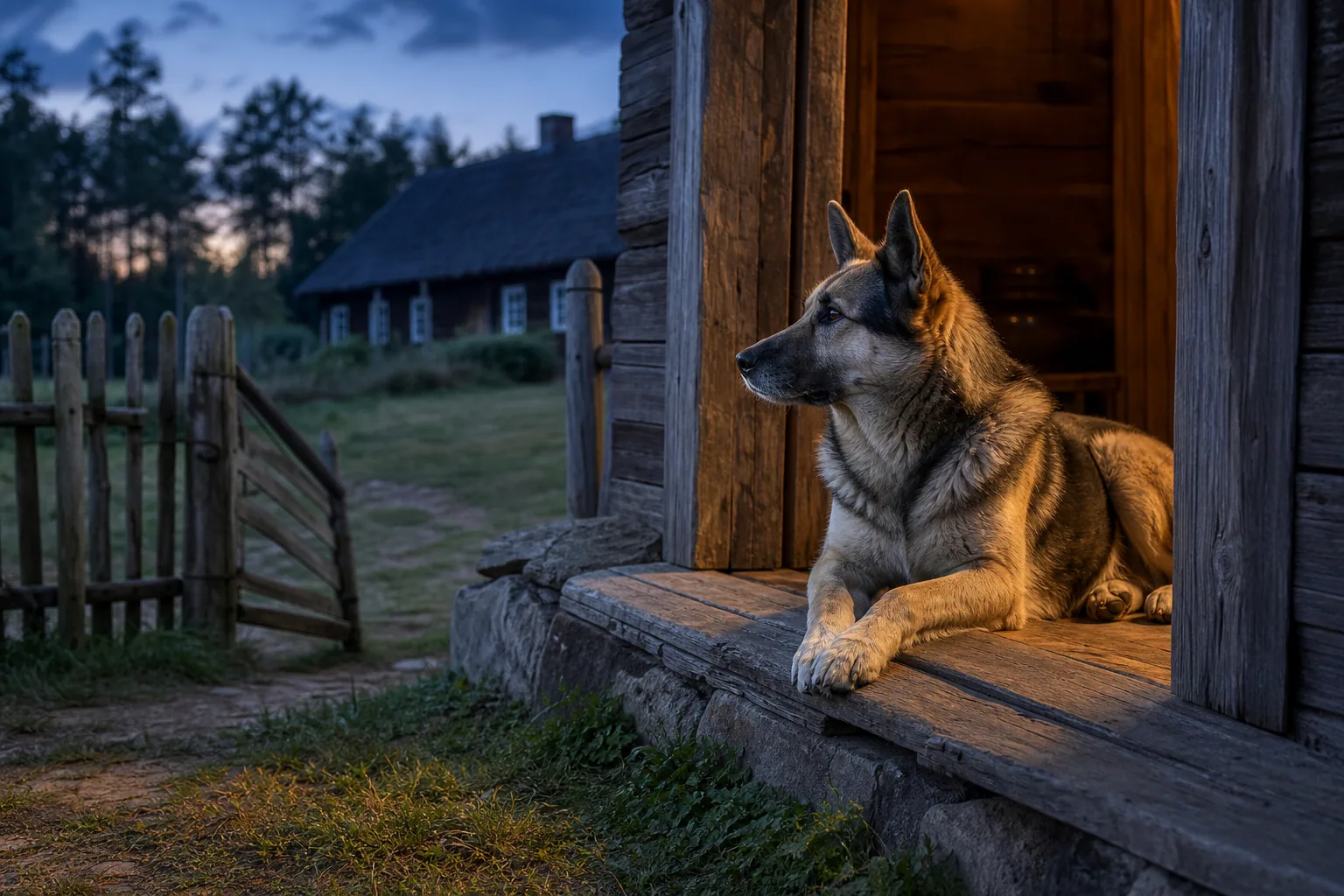
As a threshold animal the dog has both protective and liminal shades. It is first to sense an approaching stranger, and in folk understanding it also senses what humans cannot see: a ghost, a vėlė, or approaching misfortune.
For that reason the dog's behavior was watched carefully. A restless dog, suddenly alarmed or barking into darkness, could mean that something more than the eye can see was in the yard.
Foreknowledge of death: the howling dog
Perhaps the clearest belief about the dog is its ability to sense death. It was believed that a long, sorrowfully howling dog, especially with its muzzle lowered toward the ground, foretells death in the house or village.
A dog that begins digging a hole in the yard or near the house was explained similarly: such a mark was read as a sign that a grave would soon be needed. These beliefs show that the dog was understood as an animal sensing what is invisible to the living.
This foreknowledge of death places the dog in the chthonic layer of mythology, connected with earth, underworld, and the dead, a field studied by Norbertas Vėlius.
The black dog and the devil
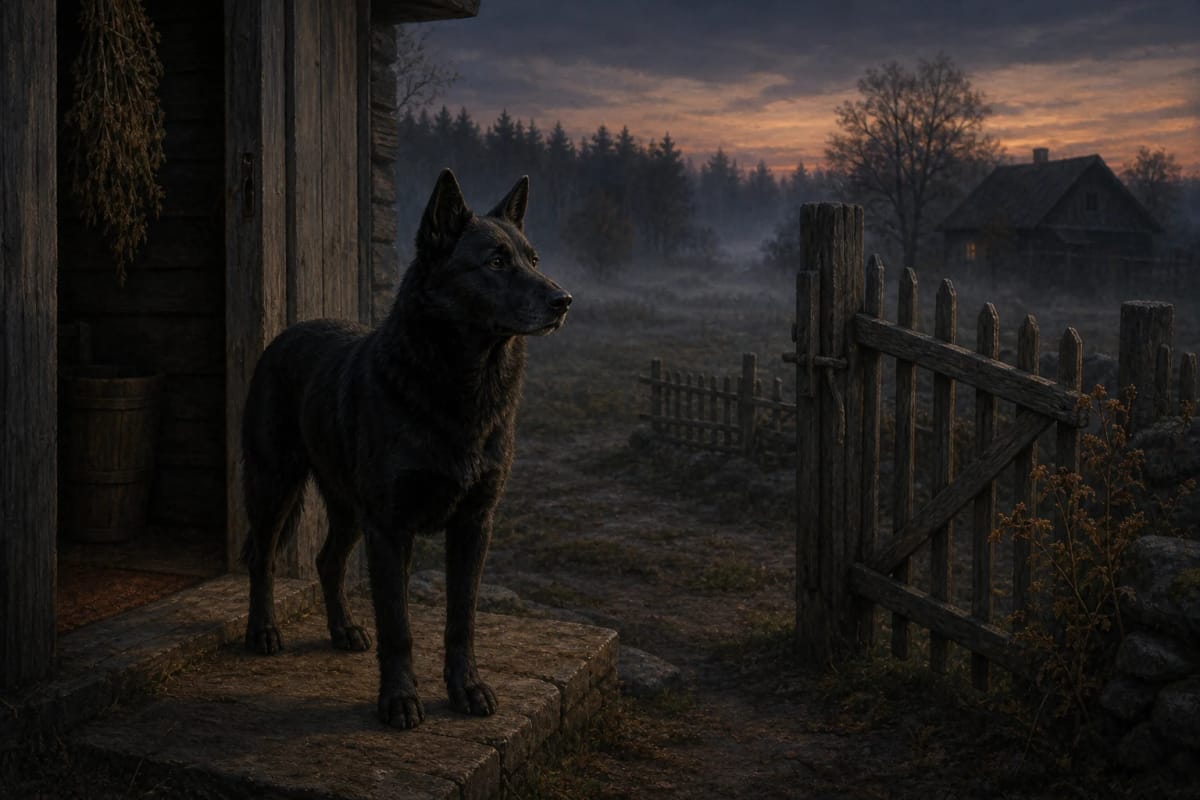
In Lithuanian legends the devil often appears in animal form, and one of his most common forms is a black dog. A black dog met at night near a bridge, crossroads, or marsh in legends often proves to be the evil one.
This connection is logical: in Lithuanian folklore the devil is a chthonic being connected with underworld and darkness, while the dog is a boundary animal keeping watch at night. Black color strengthens the shade of danger and the otherworld.
Still, not every black dog is the devil. The circumstances of the legend matter: night, a boundary place, and the animal's strange behavior. These turn the black dog into a form of the devil.
Perkūnas' dog
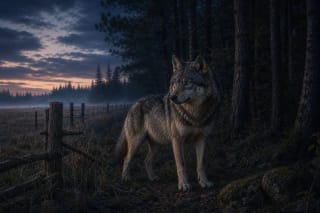
Folklore also has the name 'Perkūnas' dog'. It most often refers to the wolf, understood as an animal of the thunder god, or more generally to a mythical animal of heavenly forces that helps Perkūnas.
This name links dog and wolf into one paired image: the wolf is called 'God's dog', and 'Perkūnas' dog' is often applied to that same wolf. Domestic dog imagery thus also penetrates the symbolism of the wild predator.
Through this connection the dog gains not only a chthonic shade but also a heavenly one. Depending on the legendary field in which it appears, it can be both an animal of death foreknowledge and a servant of Perkūnas.
The dog as guardian between worlds
Taken together, these meanings reveal a general image: the dog is a guardian between worlds. It keeps watch not only at the homestead gate, but also symbolically at the boundary between the living and the dead, between household order and otherworldly chaos.
This role as world-guardian fits the wider circle of chthonic animals studied by Vėlius: animals of earth, underworld, and death that sense what lies beyond the visible world.
For that reason a dog's howling or restlessness was not read as accidental, but as a message from beyond, a warning worth hearing.
How should the dog be read today?
Today the dog is worth seeing not only as a faithful friend, but as a rich folklore symbol: a threshold guardian, an animal of death foreknowledge, and a liminal being between worlds.
The dog is best explained together with the devil, Perkūnas, and the wolf. Then it becomes clear how the same animal can be household protector, devil form, and 'Perkūnas' dog'. This layered quality makes the dog a living image in Lithuanian mythology.