
Young Days lyrics and meaning
Augo darže klevelis,
Liūdo darže rūtelės,
Liūd, liūd, liūdo
Jaunosių dienelių.
Ar tav gaila tetužės,
Ar senosės močiutės,
Ar tav gaila, jaunoji,
Jaunosių dienelių?
Ne man gaila tetužės,
Nei senosės močiutės;
Tai gaila man, tik gaila
Jaunosių dienelių.
Eik, močiute, tolimu,
Nešk vainiką šalimu.
Žinai, motinėle, pati,
Kad aš ne nešiosiu.
View illustration
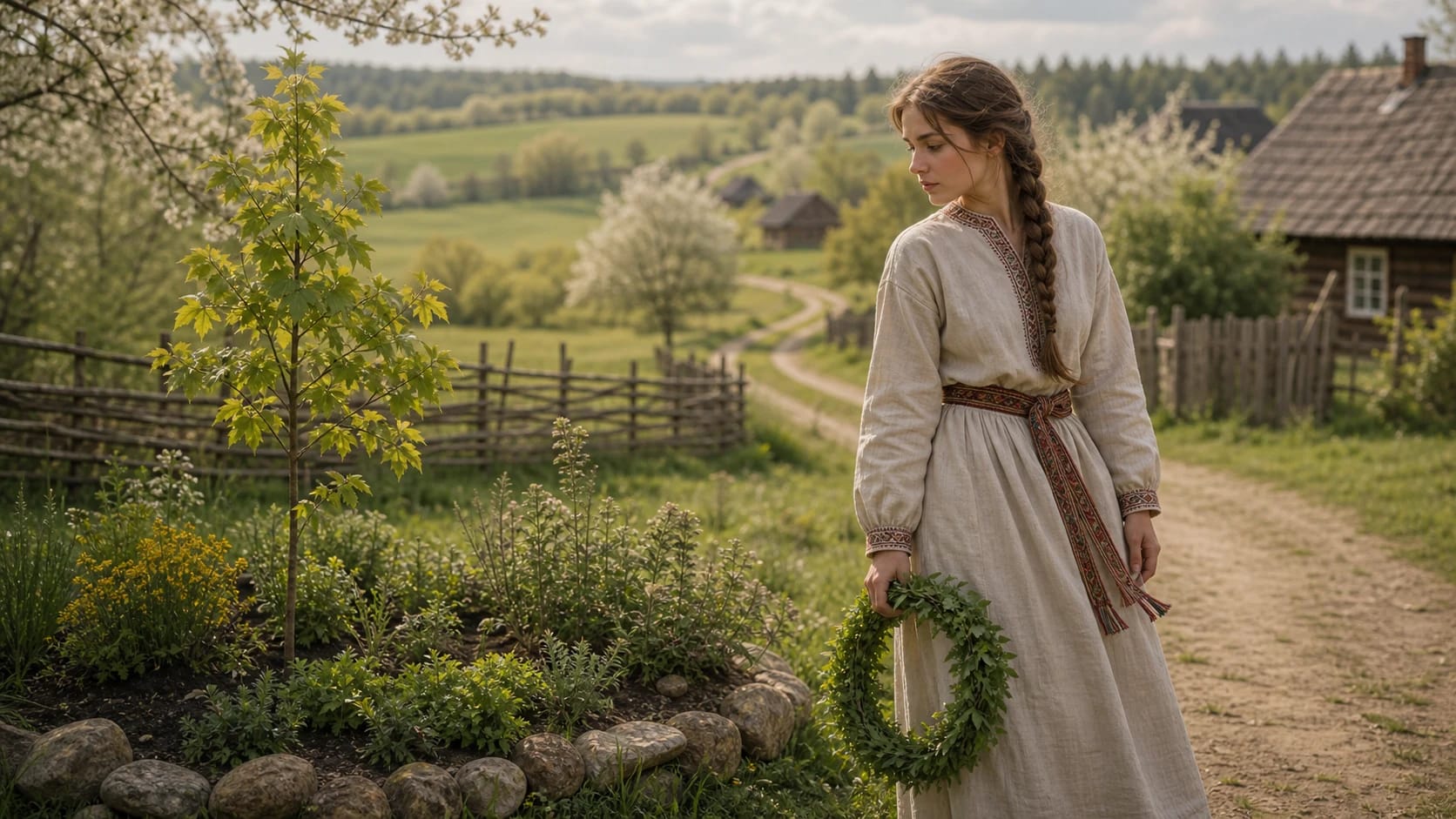
Young Days: song interpretation
The song asks what the young woman grieves for: her relatives or her youth. The answer is clear: most of all she grieves for her young days. It is a deeply human, unsentimental admission that a life boundary has been crossed.
Rue and the wreath make this transition visible. The wreath is carried away because the former order of maidenhood will no longer remain. The garden remains, but the young woman's place within it has changed.
Young Days: symbols and phrases
- Young days
- Passing youth, which the song mourns as time that cannot be recovered.
- Maple
- A garden tree beside which sorrow takes on a natural image.
- Rue
- A plant of maidenhood and honor. Its sadness mirrors the young woman's state.
- Wreath
- A sign of an unmarried young woman. Carrying it away signals a wedding or life transition.
Young Days: song history
"Jaunoses dieneles" in Rhesa's collection is a rare but very clear song of mourning for youth. Commentary shows that title and form variants shift among "jaunoses," "jaunosios," and "jaunuju dieneliu," but the main motif is the same: the days of youth are ending.
The text is close to the world of wedding transition songs. The wreath will no longer be worn, so the song speaks not only about time, but about a change in social state.
Young Days: sources
Young Days: frequently asked questions
What does "jaunoses" mean?
It is an older or dialectal form close to "jaunosios" or "jaunuju." It refers to the days of youth.
Young Days: is this a wedding song?
It is very close to a wedding transition song, because it speaks about no longer wearing the wreath and about the end of youth.
Why does the rue grieve?
The rue is personified as a reflection of the young woman's state. Its grief marks the end of maidenhood.
Why does the young woman not grieve as much for her parents?
This is a poetic focus on youth. She does not deny family, but emphasizes the days that will not return.
What does carrying the wreath away mean?
It is a sign that the young woman will no longer wear it. The wreath is removed from her former everyday life.
Why does the title's spelling differ in sources?
In old manuscripts and printed editions, dialect and editorial spelling often vary, so the same motif appears in several forms.