
Mother, My Heart lyrics and meaning
Motula mano, širdela mano,
Nesiūk adomaško man šniūrokėlės.
Motula mano, tikroji mano,
O tik siūk man baltus marškinėlius.
Motula mano, širdela mano,
Nežadėk manęs jaunam berneliui.
Nežadėk manęs jaunam berneliui,
Tik guldyk mane balton trūnelėn.
Balton trūnelėn aukštam kalnely,
Aukštam kalnely, kur bėga kelialis,
Iš tolimos šalies, gudo žemelės,
Kur guli miega jaunasis bernelis.
View illustration
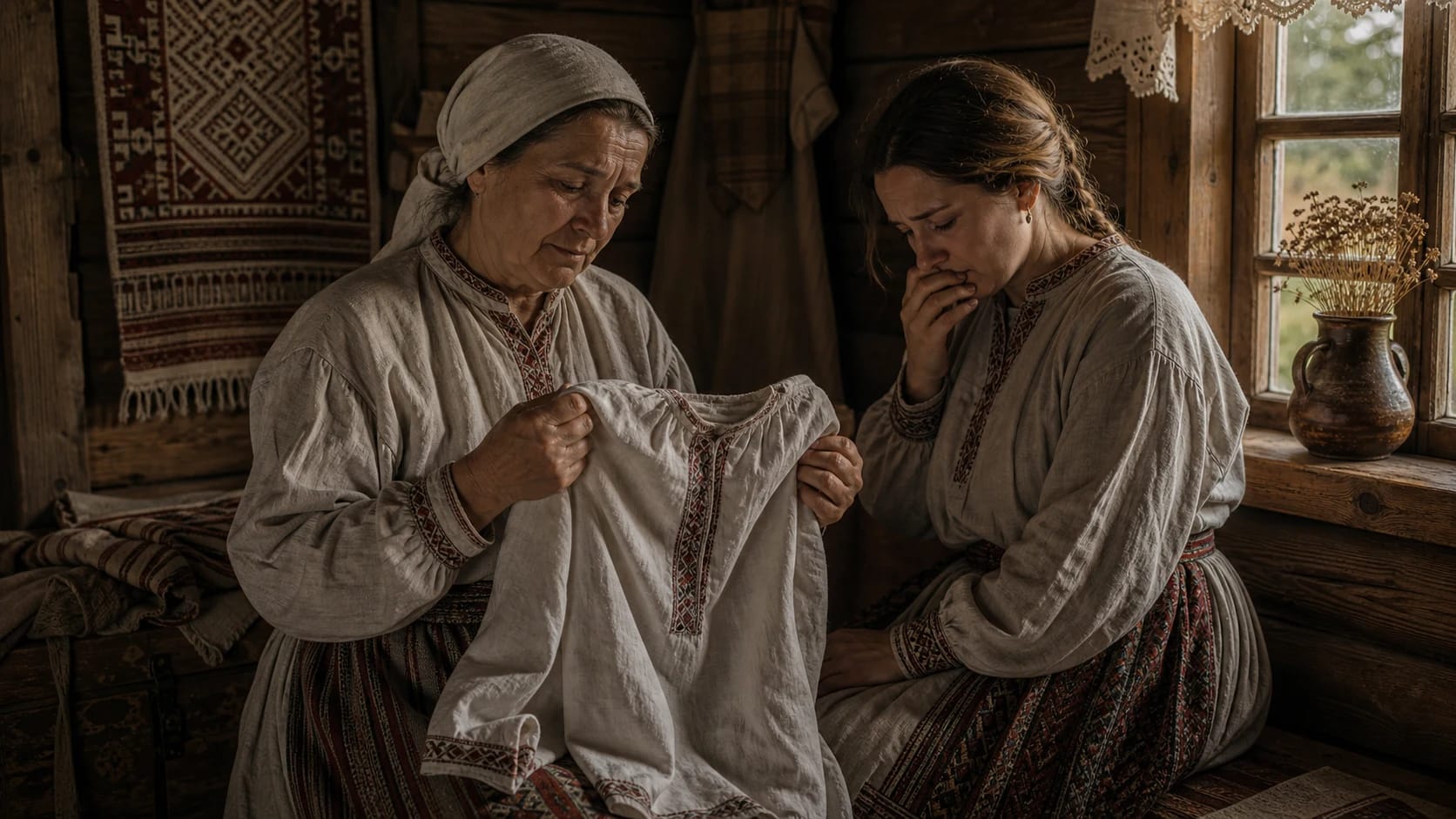
Mother, My Heart: song interpretation
The address to the mother is exceptionally tender: "motula," "my little heart," "my true one." That tenderness makes the pain of the content even stronger. The daughter does not want to be promised to a young man, because her thought is already turned toward the grave and the dead beloved.
The white shirt and the white trūnelė, or little coffin, create a link between bridal whiteness and funeral whiteness. The song painfully shows how the language of marriage can turn into lament.
Mother, My Heart: symbols and phrases
- Motula
- An affectionate address to the mother, emphasizing the close and painful bond between mother and daughter.
- White shirt
- A garment of dressing and transition. Here it belongs more to burial than to marriage.
- White trūnelė
- An image of a coffin. Its whiteness joins purity, death, and the inversion of bridal symbols.
- Gudian land
- A distant land where the young beloved lies. It extends loss beyond the home.
Mother, My Heart: song history
"Mother, My Heart" has a strong trace in sound archives. In LLTI catalogues, some recordings are classified as song, while others approach lament, making this text important for understanding the boundary between song and lament.
In the Dainava collection, this version speaks in the daughter's voice. She asks her mother not to prepare her for a wedding or a life meant for a young man, but instead to sew white shirts and lay her in a white trūnelė. This is not the joy of marriage, but a song of death and lost love.
Mother, My Heart: sources
Mother, My Heart: frequently asked questions
What do "motula" and "širdela" mean?
They are tender dialectal forms addressing the mother and the heart. They give the song the intimacy of a lament.
Is this a song or a lament?
In the sources it can stand close to both. The text has song form, but its emotional function is strongly lament-like.
What is a trūnelė?
It is an image of a coffin or burial box. The daughter asks not for a wedding, but to be laid in a white trūnelė.
Why is the color white so important?
White can mean purity, marriage, and burial. This song deliberately brings those meanings together.
Why is Gudian land mentioned?
It marks a distant place where the beloved young man is dead or lost, intensifying the scale of separation.
Are there old audio recordings?
Yes. LLTI and LMTA sources show several recordings, including early archival variants.