
I Lost My Wreath lyrics and meaning
Nutrotijau vainikėlį
Lankoj po jovaru.
Ai, aš jauna mergužėlė,
Kaip aš apsiversiu?
Ar tu girdi, balamūtai,
Kad motulė verkia?
Ar už mano gražią cnatą
Mokėk už vainiką?
Ar tu žinai, balamūtai,
Ką tu man žadėjai,
Kai seklyčioj už stalelio
Krėslely sėdėjai?
Aš papilčiau penkis šimtus
Ant žalio stalelio.
Atsiskaityk, panytėle,
Ar pakaks dėl tavęs?
Ar man pakaks, ar man neteks,
Nebesugrįš mano cnata.
Ai, aš jauna panytėlė,
Kur aš pasidėsiu?
Nupirk tujen, balamūtai,
Raudoną stančkelę.
Nieks nežinos ir nemislys,
Kad tavo panelė.
View illustration
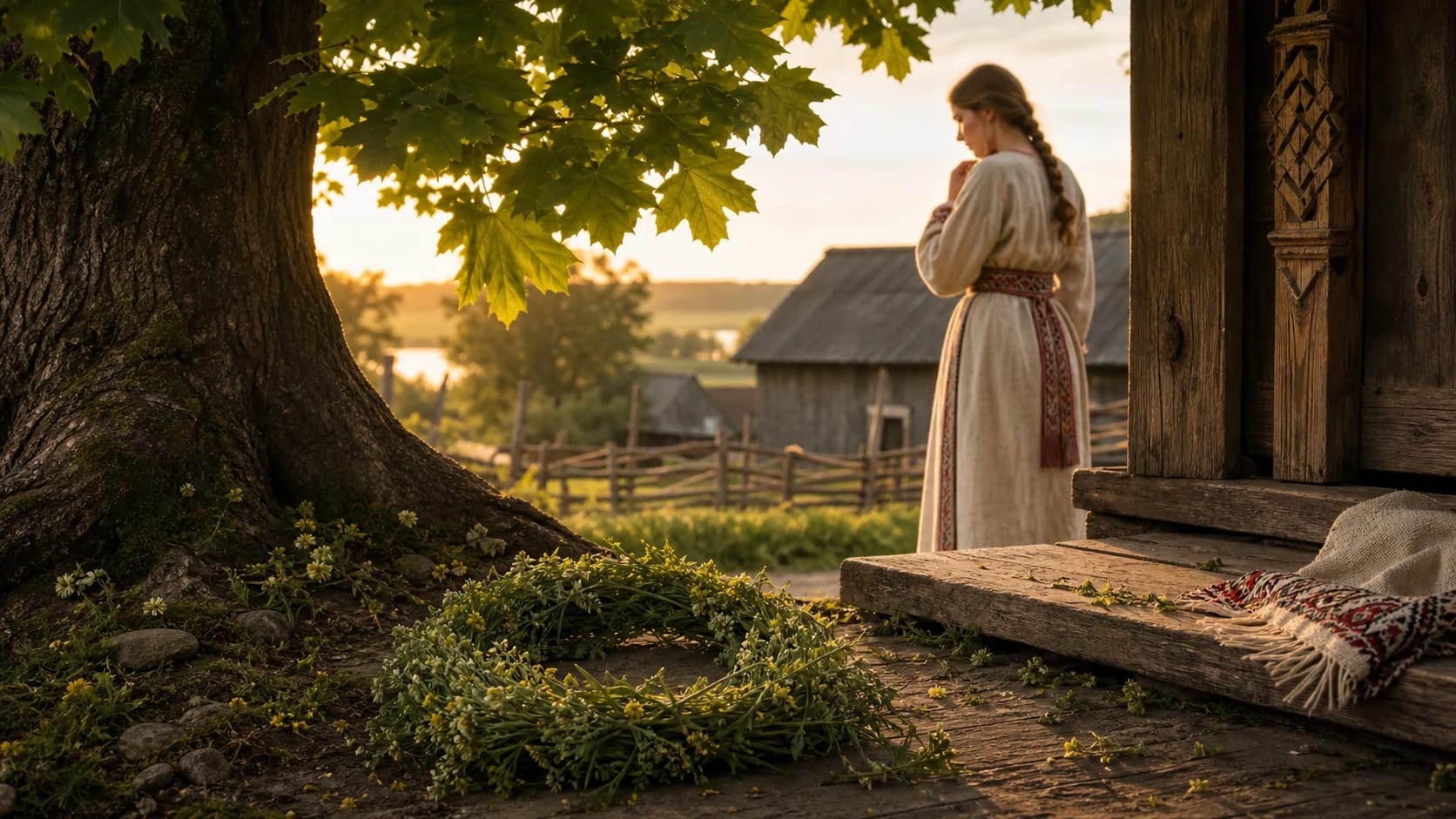
I Lost My Wreath: song interpretation
The wreath in this song is a sign of a lost boundary. It is not lost just anywhere, but in the meadow under the sycamore maple, as if in a public place dense with song symbolism. The girl asks how she will now manage, because her situation has changed not only personally but also in the eyes of the community.
The conversation with the "balamūtas" opens the question of guilt and responsibility. The man can offer money or a garment, but the song clearly says that honor does not return. For that reason the text sounds like a warning and a complaint at the same time.
I Lost My Wreath: symbols and phrases
- Wreath
- A sign of maidenhood, honor, and social status. Its loss changes the girl's place in the community.
- Sycamore maple
- The tree under which the loss occurs. It gives the scene a ritual and public character.
- Cnata
- An old word for honor or virtue. In the song it is a value that cannot be bought back with money.
- Red stančkelė
- A proposed material compensation or means of concealment. It shows that the problem is social, not only emotional.
I Lost My Wreath: song history
"I Lost My Wreath" is one of the songs in which the little wreath speaks about a girl's honor, promises, and the judgment of the community. In Juška's collection the text preserves older vocabulary: "cnata" means honor, virtue, or the value of maidenhood, while "balamūtas" points to a seducer or breaker of promises.
The trail of old printed editions shows that the song was copied and reprinted as a characteristic Lithuanian bachelorette, wedding, or love-grievance text. It is not merely sentimental: it also contains social accounting, because it speaks of promise, price, and a reputation that cannot return.
I Lost My Wreath: sources
I Lost My Wreath: frequently asked questions
What does "nutrotijau" mean?
It is an older form meaning I lost, spoiled, or was deprived of something. In the song it applies to the wreath, so it carries a shade of lost honor.
What is "cnata"?
It is an old word of Slavic origin meaning honor, virtue, or good name. It matters because the song is about reputation.
Why is the wreath so important?
In Lithuanian wedding and youth songs the wreath often marks maidenhood. Its loss means a transition or a broken promise.
I Lost My Wreath: is this a wedding song?
It is close to the field of wedding songs and songs of love grievance. The text speaks about promises, the mother's weeping, and the girl's changed status.
Who is the balamūtas?
In the song this names the man who made promises but avoids responsibility. The word has the sense of a deceiver or seducer.
Why is money on the green table mentioned?
It is an attempt to turn the loss into a settlement. The song stresses that honor cannot be recovered by money alone.