
The Woodsman-Hunter lyrics and meaning
Kad aš josiu jau šalin,
Duosiu žirgą patkavoti,
Patkavėles atkapoti.
Kad aš josiu pagiriais,
Pagirėliais jodydams,
Karvelėlius šaudydams.
Ir pamačiau mergužę
Pagirėliais vaikščiojant,
Uogeles berankiojant.
Aš nusėdęs užmigau
Ant mergatės keliužių
Ir jos lelijos rankužių.
Kai pabudau, tai neradau
Sidabrinių pentinėlių
Nei kepurės burtiko.
Ak, atduokit, kas atradot,
Man gėdos nedarykit
Ir ne mano mergužei.
View illustration
The Woodsman-Hunter: song interpretation
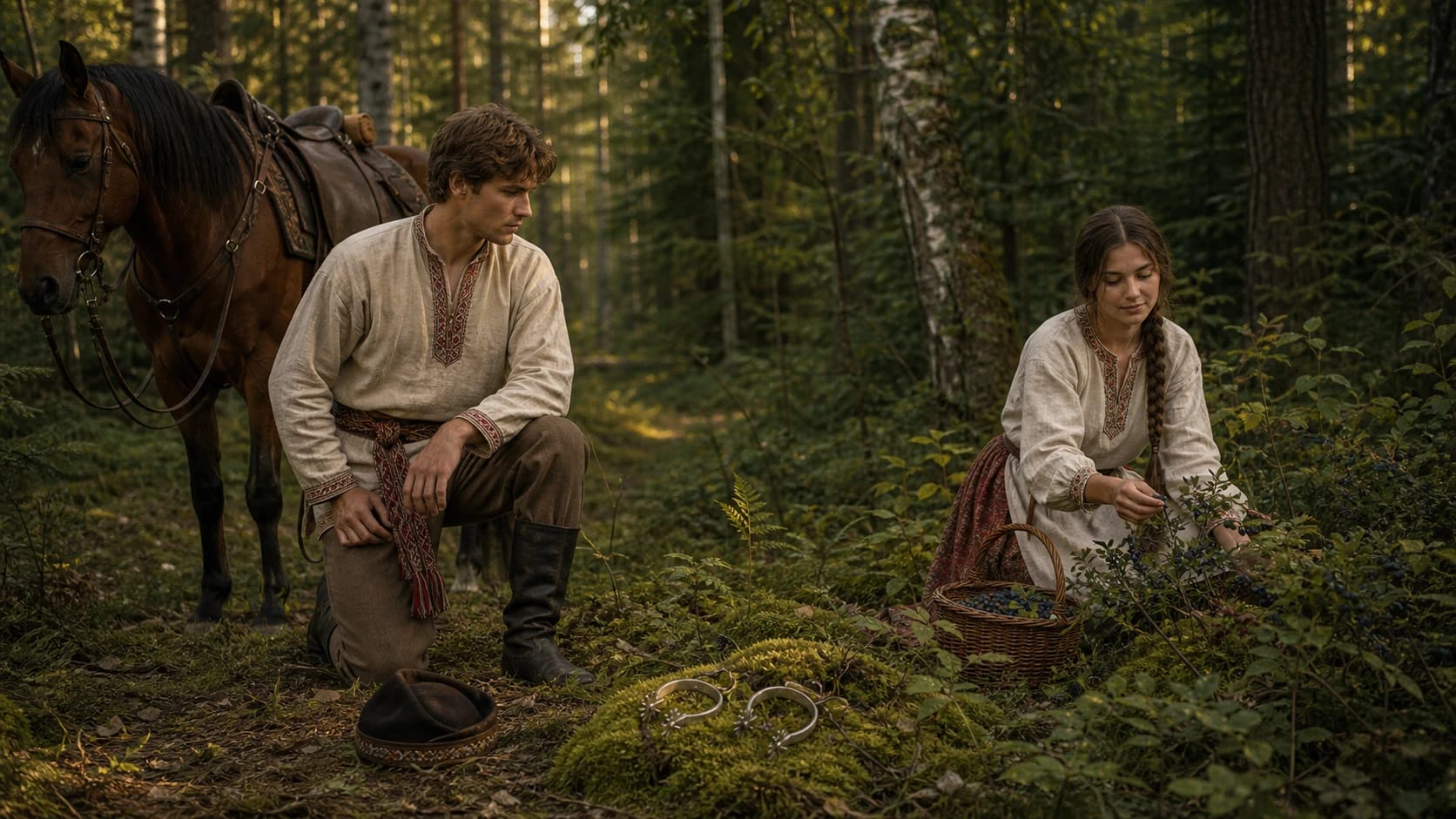
The forest here is an alluring but dangerous boundary. The young man rides into it as a hunter, yet he himself becomes vulnerable: he falls asleep and loses his spurs and the ornament of his cap. This reverses the hunter's power.
The girl with berries is not merely a detail of beauty. She belongs to the forest-edge space and creates a situation in which the young man's honor hangs on the loss of his things. The song therefore has a light erotic and comic undertone.
The Woodsman-Hunter: symbols and phrases
- Medėjis
- A hunter or forest man. He enters the forest-edge space and loses control.
- Forest edge
- A boundary between village and forest. There one can meet a girl, but also fall into an awkward situation.
- Silver spurs
- Objects of riderly status. Losing them means shame.
- Lily-like hands
- An image of the girl's softness and beauty, contrasting with the hunter's loss.
The Woodsman-Hunter: song history
Rėza's "Medėjis" is connected with the image of a hunter or forest man who has ridden out. The title is harder to find in modern searches because the word is rare and dialectal, but Rėza's text clearly presents the song's plot.
The song begins with riding out and hunting, but quickly becomes a story of an encounter at the forest edge. The hunter sees a girl gathering berries, falls asleep on her knees, and on waking no longer finds his ornate belongings.
The Woodsman-Hunter: sources
The Woodsman-Hunter: frequently asked questions
What does "medėjis" mean?
In this context it means a hunter or forest man. The word is old and rare, which makes archival searching harder.
Why are doves hunted in the song?
Shooting doves presents the young man in the role of hunter, but soon he himself becomes vulnerable.
What does sleeping on the girl's knees mean?
It is a scene of intimacy and carelessness. It allows the loss to happen and creates the song's shame motif.
Why are the spurs important?
Spurs belong to a rider's equipment and status. Losing them diminishes the young man's honor.
Is the song comic?
It has a comic undertone because the hunter, who should control the situation, wakes up robbed or made ridiculous.
Why rely on Rėza rather than sound recordings?
Direct modern recording traces are weak, but Rėza's edition provides a clear historical text and commentary.