
Whose Green Yard Is This? lyrics and meaning
Ei, kieno, kieno žalias kiemelis?
Žalio vario varteliai,
Misinginiai rakteliai.
Ei, tai yr, tai yr senos mamužės
Žalio vario varteliai,
Misinginiai rakteliai.
Eit mamužė į naują svirną,
Neranda savo dukrytės
Nei margosios skrynelės.
Tai verkia, verkia sena mamužė,
Gail jaunųjų dukryčių
Su jaunuoju bernyčiu.
Ei, neverk, neverk, sena mamuže,
Juk aš ir vėl sugrįšiu
Su jaunuoju bernyčiu.
Ei, negrįžk, negrįžk, dukryte mano,
Bandyk vargelį vargti
Su jaunuoju bernyčiu.
View illustration
Whose Green Yard Is This?: song interpretation
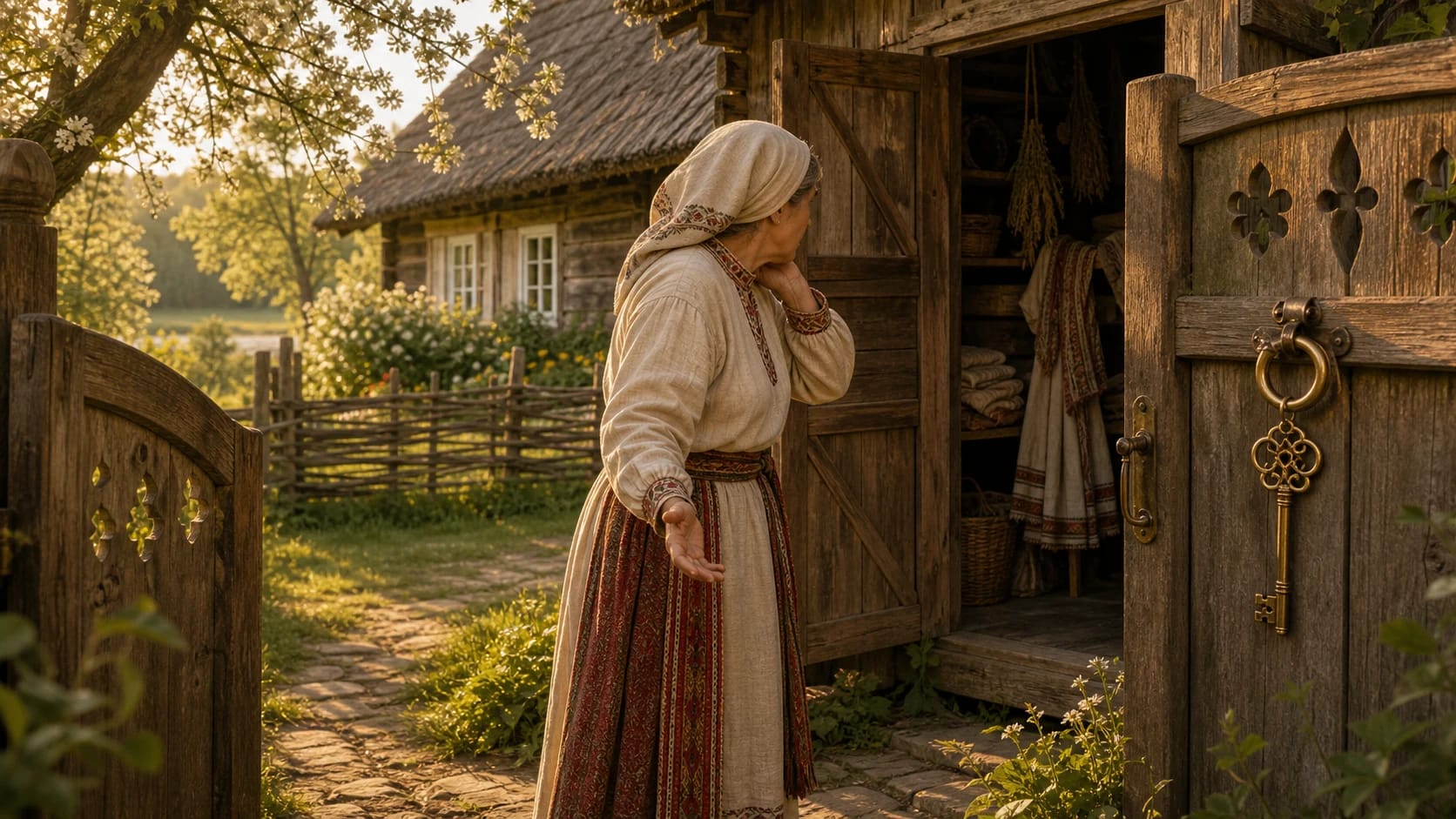
The green yard is an image of the fullness of home. It contains gates, keys, a storehouse, and a chest - everything connected with a daughter's dowry and the order of the family. When the mother no longer finds her daughter or the chest, the yard becomes empty, even though outwardly it is still green.
The final words are not coldness. The mother does not simply reject her daughter; she recognizes the wedding threshold: one cannot return to the maiden home in the same way as before. The song speaks about the difficult passage from the parents' yard into the husband's home.
Whose Green Yard Is This?: symbols and phrases
- Green yard
- A sign of a living home and family space. The greenness shows fullness, which loses the daughter.
- Copper gates and brass keys
- Ornate details of the home's boundary. They emphasize the closed, guarded world of the parents' yard.
- Storehouse
- The place of dowry and family goods. The mother's going into the storehouse reveals the daughter's departure.
- Little hardship
- The burden of a new life. The wedding song recognizes that marriage means work as well as separation.
Whose Green Yard Is This?: song history
In Rėza's commentary the song is presented as a manuscript text from Lithuania Minor, while later sound and catalogue records show that the formula "whose green yard" remained alive in a broader tradition. The opening question about whose yard this is does more than identify a place: it opens a family drama.
At the center of the song are the mother, the storehouse, the missing daughter, and the chest. This is a wedding-departure scenario: the daughter is led away or leaves with the young man, and the mother's response moves from lament to the recognition that the daughter must now "bear her little hardship" in a new life.
Whose Green Yard Is This?: sources
Whose Green Yard Is This?: frequently asked questions
Why does the song ask whose yard it is?
The question lets the listener gradually recognize the home and its drama. It is the song's way of entering the family space.
What does the green yard mean?
It is an image of a living, full home. Greenness is linked with growth, youth, and a family order not yet broken.
Why does the mother look for her daughter in the storehouse?
The storehouse is linked with the dowry and a girl's property. When the mother does not find the daughter or the chest, she understands that a wedding departure has taken place.
Is "Whose Green Yard Is This?" a wedding song?
Yes. Its motifs are very close to wedding sending-off songs: mother, daughter, chest, young man, and a new little hardship.
Why does the mother tell the daughter not to return?
It does not mean a lack of love. She names a traditional boundary: a daughter who has left must live in her new home.
Why are the gates and keys important?
They show the safety and boundaries of the home. When the daughter leaves, even ornate gates cannot hold back the change in life.