
Dawn Breaking lyrics and meaning
Beauštanti aušružėlė,
Betekanti Saulužėlė,
Beskaudanti galvelė.
Rūpinosi motinėlė,
Rūpinosi širdužėlė:
Kur išleisiu dukrelę?
Ar į kiemą kiemužėlį,
Ar į margą dvaružėlį,
Ar į aukštą kalnelį?
Ne į kiemą kiemužėlį,
Ne į margą dvaružėlį,
Tik į aukštą kalnelį.
Išauš šilta vasarėlė,
Išgins broliai žirgužėlius,
Lankys sesės kapelį.
Lankys sesės kapužėlį,
Braukys ryto rasužėlę
Su juodbėriais žirgeliais.
View illustration
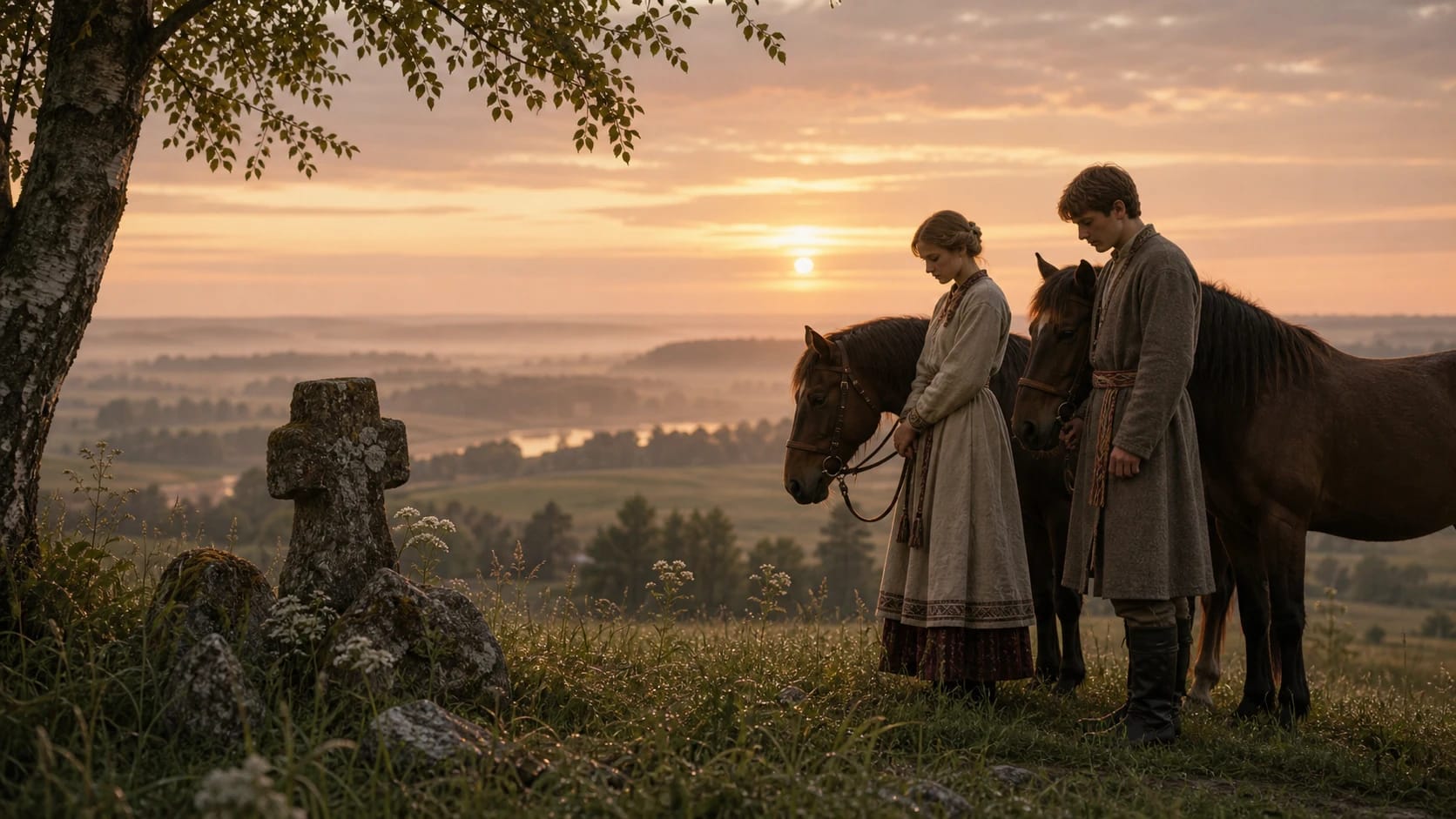
Dawn Breaking: song interpretation
The song's tender diminutives conceal very heavy content. Dawn and the little sun would usually awaken life, but here they accompany a headache and a mother's anxiety. Morning becomes not a beginning, but the time when loss is understood.
The high hill resolves the question "where shall I send my daughter" tragically. Brothers and sisters will visit the little grave and brush away the dew. This dew may be morning moisture, but it also answers to tears.
A second interpretive possibility is also important. The question "where shall I send my daughter" is a familiar formula of wedding departure, so some variants can be read not as songs of death but as songs of marriage. Then the "high hill" would be the husband's home, far away in a foreign side, and the visits by brothers and sisters would be rare meetings with a sister who has been married out. The diminutives would conceal not death but the sorrow of separation, and only the grave motif turns this particular variant toward lament.
Dawn Breaking: symbols and phrases
- Dawn
- A sign of transitional time. Here it not only wakes the world but also opens the morning of loss.
- Mother's care
- The center of family pain. The mother considers her daughter's fate but cannot change it.
- High hill
- A place of burial and separation. It replaces the expected future of yard or manor.
- Morning dew
- An image of visiting the grave. It may mean both natural moisture and the tears of relatives.
Dawn Breaking: song history
"Dawn Breaking" has a strong archival trace: it is recorded in printed collections, musical notation, and sound recordings. In the Juška variant the song is not a simple greeting to morning, but a mother's anxiety over her daughter's fate.
Dawn, the sun, and the aching head open a state between night and day. The mother wonders where to send her daughter, but the answer unexpectedly leads not to a yard or manor, but to a high hill, the space of a grave. For that reason this variant stands close to lament and the field of family bereavement.
Dawn Breaking: sources
Dawn Breaking: frequently asked questions
Is "Dawn Breaking" always a sad song?
Not all variants are identical, but in the Juška variant the dawn image is clearly connected with the daughter's death and the grave motif.
Why does the head ache at the beginning?
It is a bodily sign of grief. The song starts from a physical feeling and then reveals the mother's anxiety.
What does the high hill mean?
In this text it is the place of the grave. In folk songs a high hill often becomes a space of separation and remembrance.
Why will brothers and sisters visit the grave?
It is an act of family remembrance. They cannot bring the daughter back, but they maintain a bond by visiting.
Why is dawn important?
Dawn marks the passage from darkness to day, but here it brings awareness of pain. Morning beauty contrasts with bereavement.
Was the song harmonized or arranged?
Yes. Archives preserve notation and sound recordings, so the song lived both in village singing and in later musical culture.