
Beyond the Blue Waters lyrics and meaning
Už marelių, už mėlynųjų
Arė bernelis pūdymėlį.
Arė bernelis pūdymėlį,
Nešė motulė priešpietėlius.
Nenešk, motula, nevalgysiu,
Palšų jautelių nestabdysiu.
Palšų jautelių nestabdysiu,
Lygioj lankelėj neganysiu.
Lygioj lankelėj neganysiu,
Sraunioj upelėj negirdysiu.
Už marelių, už mėlynųjų
Arė bernelis pūdymėlį.
Arė bernelis pūdymėlį,
Nešė sesulė priešpietėlius.
Nenešk, sesula, nevalgysiu,
Palšų jautelių nestabdysiu.
Palšų jautelių nestabdysiu,
Lygioj lankelėj neganysiu.
Lygioj lankelėj neganysiu,
Sraunioj upelėj negirdysiu.
Už marelių, už mėlynųjų
Arė bernelis pūdymėlį.
Arė bernelis pūdymėlį,
Nešė mergelė priešpietėlius.
Tai nešk, mergele, tai valgysiu,
Palšus jautelius tai stabdysiu.
Palšus jautelius tai stabdysiu,
Lygioj lankelėj tai paganysiu.
Lygioj lankelėj tai paganysiu,
Sraunioj upelėj tai pagirdysiu.
View illustration
Beyond the Blue Waters: song interpretation
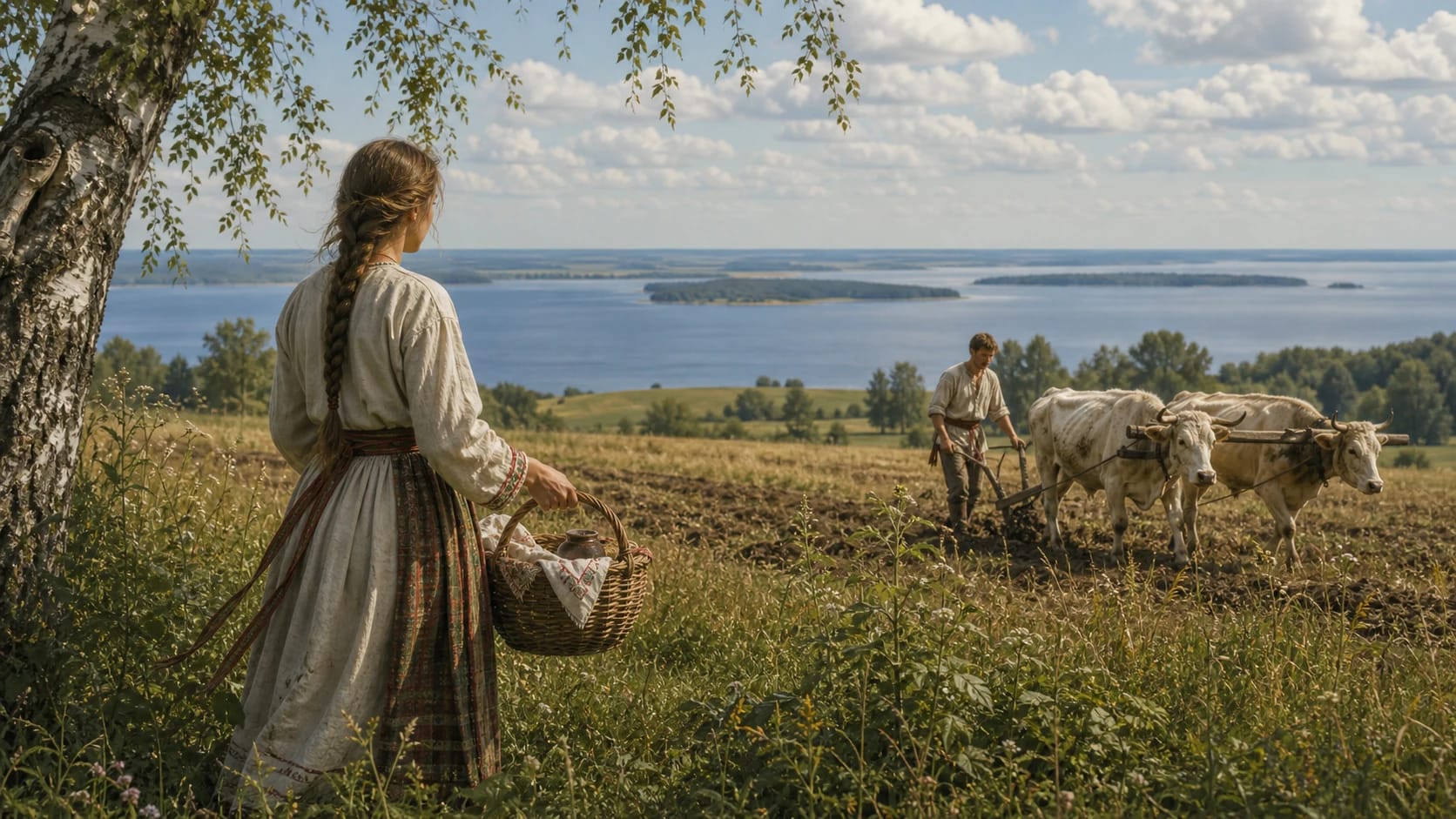
The young man is beyond the water, beyond the blue distance, ploughing fallow land. Ploughing shows hard work and masculine maturity. Yet his willingness to eat depends not on the food itself, but on who brings it.
Mother and sister are close family figures, but the young woman introduces a different bond. Only when she arrives does he promise to stop the oxen, let them graze, and water them. The song shows how a love bond can briefly surpass the care of family.
Beyond the Blue Waters: symbols and phrases
- Blue waters
- A distant boundary and separation. It makes the ploughman's place feel almost tale-like in its remoteness.
- Fallow field
- Land of work and preparation. Ploughing shows everyday labor, but also the making of life.
- Pale grey oxen
- The ploughman's working pair. Stopping them means that care brought by love can interrupt work.
- Mid-morning meal
- A sign of care and relationship. What matters is not the food itself, but the person who brings it.
Beyond the Blue Waters: song history
In the Dainava region collection, this text was recorded from Anė Mickevičaitė, a singer from Subartonys. Its opening, "beyond the waters, beyond the blue ones," belongs to a very widespread Lithuanian song formula in which the distance of water marks a foreign, difficult-to-reach, or fatefully separated space.
This version is especially clear in its repetition: the ploughman refuses the mid-morning meal brought by his mother and sister, but accepts the one brought by the young woman. This creates a simple but strong plot of love's preference.
Beyond the Blue Waters: sources
Beyond the Blue Waters: frequently asked questions
What do the waters mean in this song?
The waters mark a broad distance and boundary. In the song they separate the ploughman from home and make the scene feel special.
Why does the young man refuse his mother and sister's food?
The logic of repetition emphasizes the young woman's special place. He is not rejecting family as such; the song highlights the force of love.
What is fallow land?
It is land being worked or prepared for cultivation. In folk song, ploughing often suggests labor, maturity, and the ordering of the farm.
Why are the oxen called pale grey?
The Lithuanian word describes a greyish or light grey color. The detail gives the work scene specificity.
Is this a love song?
Yes. This version clearly turns toward a love choice, because only the young woman's care stops the ploughman's work.
Are there other songs beginning "beyond the waters"?
Yes. It is a very productive opening formula, so different texts can begin similarly while carrying different plots.