
Ah, Trouble, Trouble lyrics and meaning
Ai, bėda, bėda,
Bėda prie bėdos,
Kad mergužė už vandens.
Pats pušį kirtau,
Laivužį dariau,
Pats mergužę perkėliau.
Kolei perkėliau,
Tolei tylėjo,
Šilkų šiūbą dėvėjo.
O kai perkėliau,
Pradėjo verkti,
Kaip gegutė kukuoti.
Ei, cit, neverki,
Mano merguže,
Baltoji lelijėle.
Gale tėvelio
Margo dvarelio
Balta ieva žydėjo.
O tie žiedeliai,
O tie baltieji
Vedė juodas uogeles.
Juodos uogelės -
Tai ašarėlės,
Balti žiedai - žodeliai.
Show translation
This translation explains the words; it is not a singable adaptation.
Lithuanian lyrics
Ai, bėda, bėda,
Bėda prie bėdos,
Kad mergužė už vandens.
Literal meaning
Ah, sorrow, sorrow,
Sorrow upon sorrow,
For my girl is across the water.
Lithuanian lyrics
Pats pušį kirtau,
Laivužį dariau,
Pats mergužę perkėliau.
Literal meaning
I felled the pine myself,
I made a little boat,
I ferried the girl across myself.
Lithuanian lyrics
Kolei perkėliau,
Tolei tylėjo,
Šilkų šiūbą dėvėjo.
Literal meaning
While I ferried her across,
She kept silent,
Wearing a silk gown.
Lithuanian lyrics
O kai perkėliau,
Pradėjo verkti,
Kaip gegutė kukuoti.
Literal meaning
But when I had brought her across,
She began to weep,
To call like a cuckoo.
Lithuanian lyrics
Ei, cit, neverki,
Mano merguže,
Baltoji lelijėle.
Literal meaning
Hush now, do not weep,
My dear girl,
My white little lily.
Lithuanian lyrics
Gale tėvelio
Margo dvarelio
Balta ieva žydėjo.
Literal meaning
At the edge of father's
Fine homestead,
A white bird cherry bloomed.
Lithuanian lyrics
O tie žiedeliai,
O tie baltieji
Vedė juodas uogeles.
Literal meaning
Those little blossoms,
Those white ones,
Bore little black berries.
Lithuanian lyrics
Juodos uogelės -
Tai ašarėlės,
Balti žiedai - žodeliai.
Literal meaning
The black berries
Are little tears;
The white blossoms are words.
View illustration
Meaning
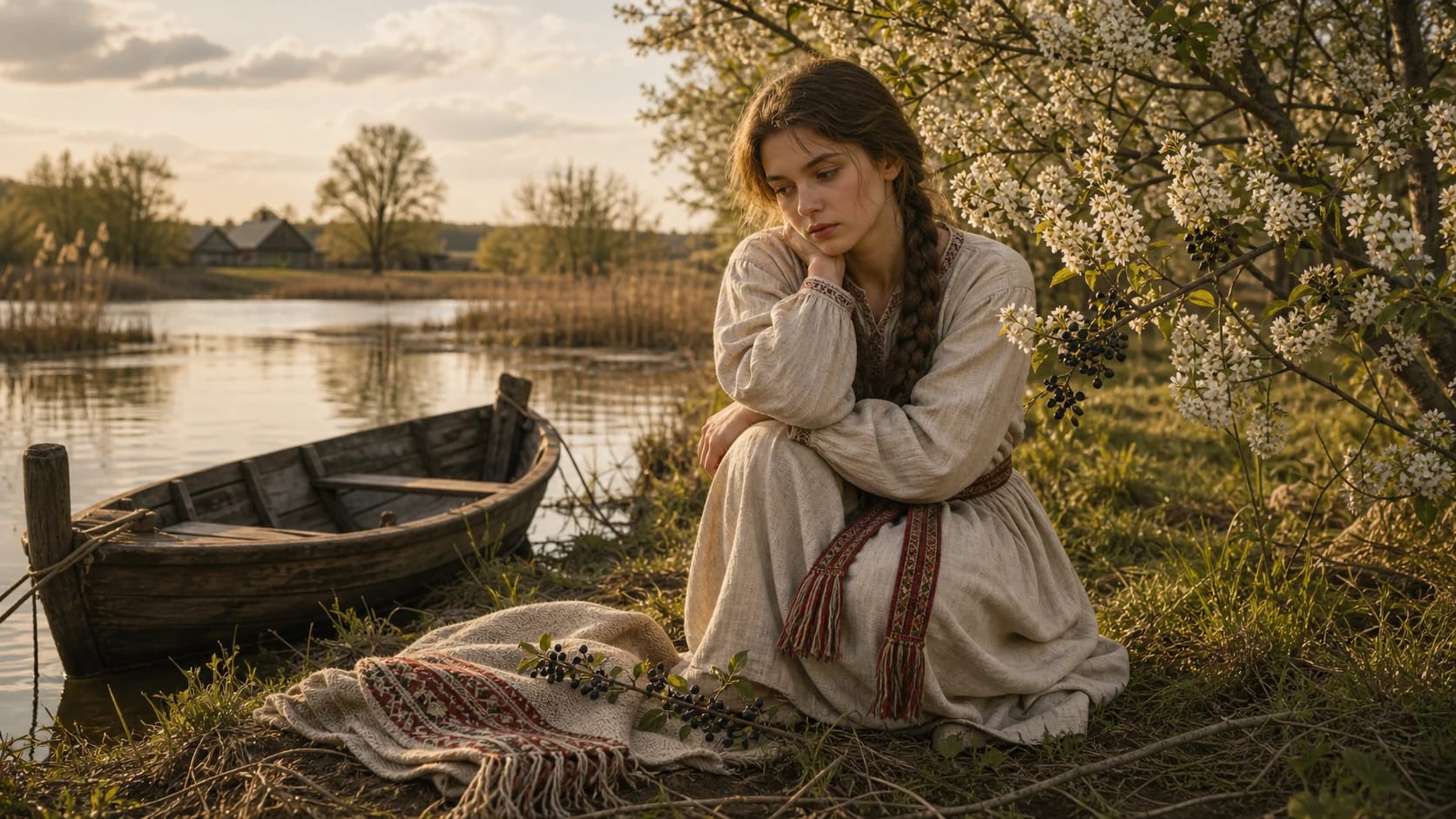
Water acts as a boundary in the song. While the young woman is still on the far side, she can be reached only through effort: the young man must cut down a pine, make a small boat, and ferry her across. Yet once she has crossed, she begins to weep, so the journey over water means more than an ordinary meeting. It signals a change of fate.
The bird cherry's blossoms and dark berries create a sharp contrast. Whiteness recalls beautiful words, while blackness becomes tears. The song subtly shows how enticement and promises can turn into pain.
A second reading is also possible. The crossing over water and the weeping "like a cuckoo" allow the song to be understood as a wedding departure motif. In folk tradition, a young woman carried across water to the man's side leaves her parents' home, and the cuckoo is associated with the longing of a sister or daughter being led away. In that reading, the "trouble" is not a failed love affair, but the threshold of marriage itself, and the weeping begins precisely after crossing the water, when the tie to the old life has been cut.
Symbols
- Trouble upon trouble
- A chain of sorrows. The repetition lets the song sound both like a lament and like a rhythmic formula.
- Water
- A boundary between a former and a new state. Being ferried across the water changes the young woman's position.
- Small boat
- The means of crossing, made by the young man himself. It shows his active effort to reach the young woman.
- White bird cherry and dark berries
- A contrast between promises and pain. White blossoms are linked with words; dark berries with tears.
History
"Ah, Trouble, Trouble" belongs to songs in which the repeated trouble formula may be both sincere lament and sung exaggeration. In Juška's version, the story centers on a young woman beyond the water: the young man himself cuts a pine, makes a boat, and ferries her over, but the crossing brings not joy, but weeping.
The audio recordings and LLTI variant titles show that this formula was widely used. In different regions, "trouble" may mean a love misfortune, a family concern, a wedding separation, or a humorous complaint.
Sources
Common questions
Why is the word "trouble" repeated so much?
The repetition intensifies both feeling and rhythm. In Lithuanian folk songs, such a formula can be a genuine complaint or a comic sung exaggeration.
Why is the young woman "beyond the water"?
Water marks distance and a boundary. Once it is crossed, the relationship changes, so the young woman's weeping is not accidental.
What do the pine cutting and boat making mean?
They show the young man's effort to reach the young woman. He does not simply wait; he creates a way across the boundary himself.
Why does the young woman weep like a cuckoo?
In Lithuanian songs, the cuckoo is often linked with longing, orphanhood, and complaint. Here it intensifies the image of her weeping.
What does the white bird cherry mean?
At first the white bird cherry seems beautiful and pure, but its dark berries show that beautiful words can bring tears.
Does this song have many variants?
Yes. ePaveldas and printed collections show a broad family of variants beginning with the "Ai bėda" formula.