- Instrument family
- Other instruments
- Type
- Shaken idiophone, livestock neck rattles, shepherds, village-band rhythm, orchestral skrabalai
- Source status
- well attested
skrabalas, kankalas
What are skrabalai?
Skrabalai, also called kankalai, baškalai, or tarškučiai, are Lithuanian shaken, more rarely struck, idiophones. Their first purpose was practical rather than musical: shepherds hung them on livestock necks to find animals more easily while grazing.
From this everyday tool a musical instrument later emerged. Individual skrabalai were made for music-making, and their sound color and rhythm fitted into village bands, especially in Dzūkija.
Construction and sound
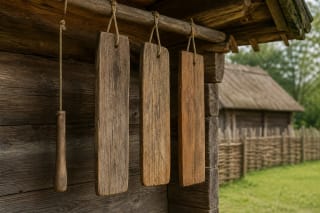
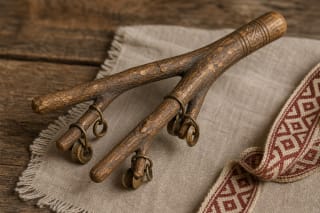
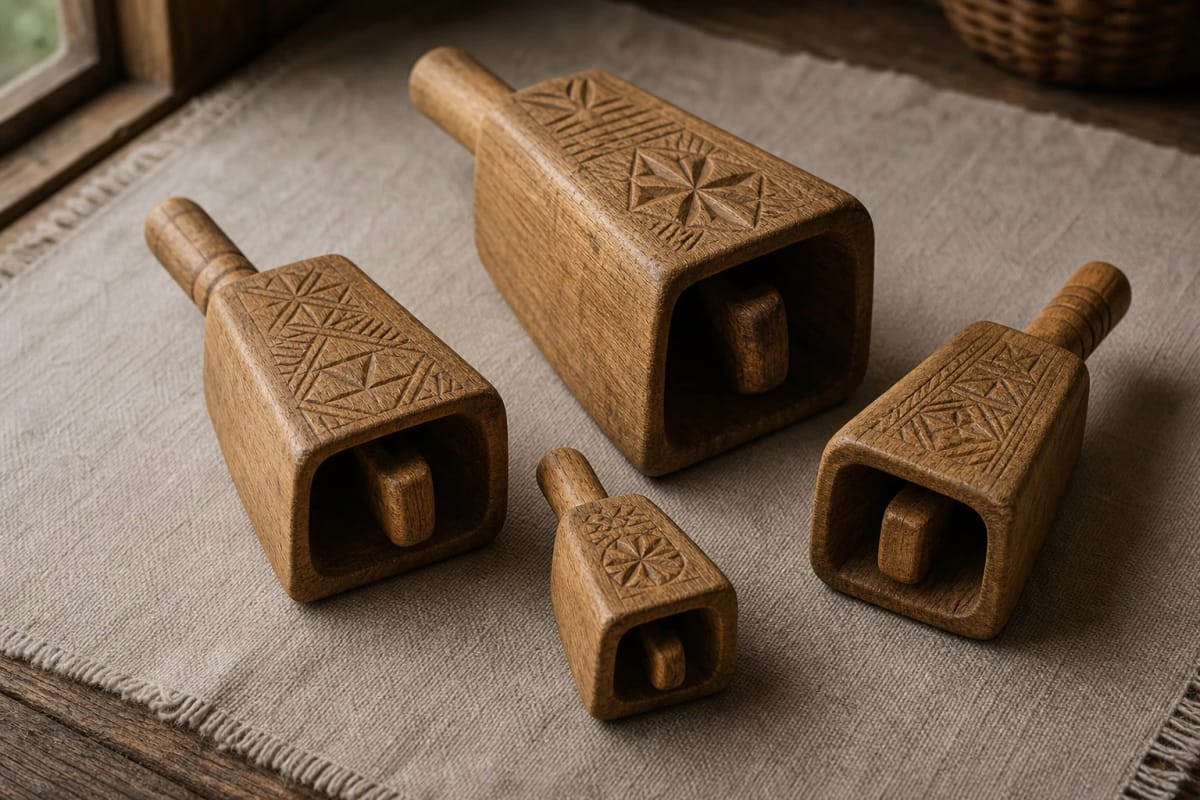
A skrabalas is a hollowed wooden trapezoid box, a metal cylinder or cone-shaped box, or sometimes a rectangular board, with 1-3 clappers hanging inside. Wooden skrabalai had carved, and metal ones stamped, owner initials, year of making, ornaments, and 1-3 sound holes.
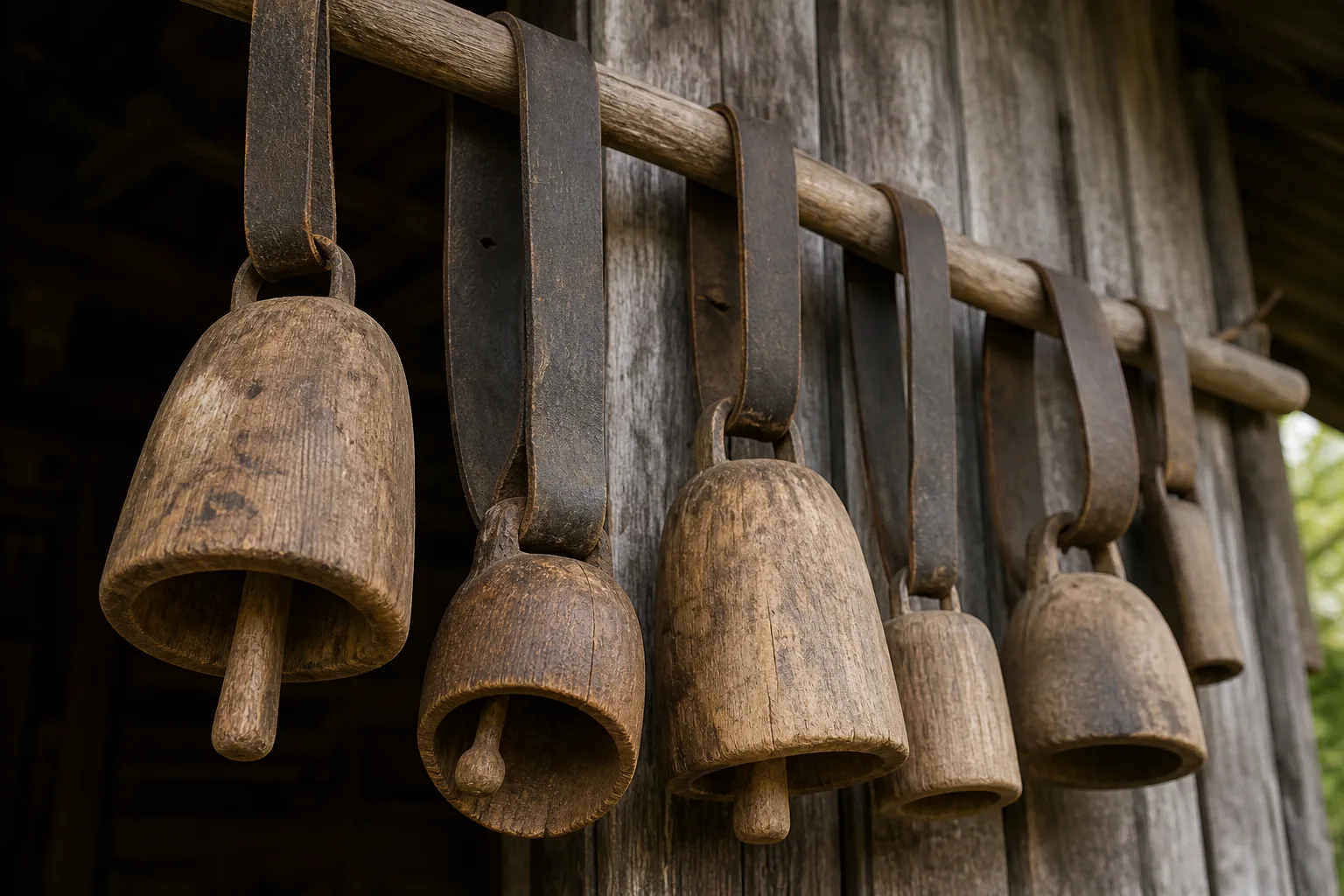
When shaken, the clappers strike the walls and make the characteristic rattling sound. In village bands, wooden skrabalai without clappers are struck with two sticks; earlier they were attached to a stick driven into the ground, and still today they may be attached to a drum to add sharp wooden color to rhythm.
History and tradition
From old times until the twentieth century, skrabalai were tied under the necks of grazing cattle, one of their oldest and most practical roles. Sometimes village musicians shook wooden skrabalai by hand, and Dzūkija bands used them for sound color.
Skrabalai show how a village household object becomes a musical instrument: the same object that helped keep track of a cow gained rhythmic and timbral functions in shared music-making.
Skrabalai today
In 1947 Pranas Serva, following a design by Jonas Švedas, made modified 9-box skrabalai with range d1-d2, joined with a pedal drum, kelmas. Folk-instrument ensembles and orchestras use 27-box skrabalai, whose boxes are fixed to 7 crossbars and struck with two sticks.
Thus a simple livestock-neck skrabalas grew into a xylophone-like melodic instrument with the scale c1, d1, e1, f1-e3. Skrabalai remain one of the most recognizable Lithuanian idiophones in folklore ensembles.