- Place
- Tverai, Rietavas Municipality
- Region
- Samogitia
- Type
- Lithuania's largest wooden church with a miraculous Marian image
- Address
- Žemaičių alėja 6, Tverai, Rietavas Municipality
- Coordinates
- 55.73333, 22.14880
Tverai Church of the Visitation of the Blessed Virgin Mary, Tverai church building complex
Tverai Church: the Largest Wooden Church in Lithuania
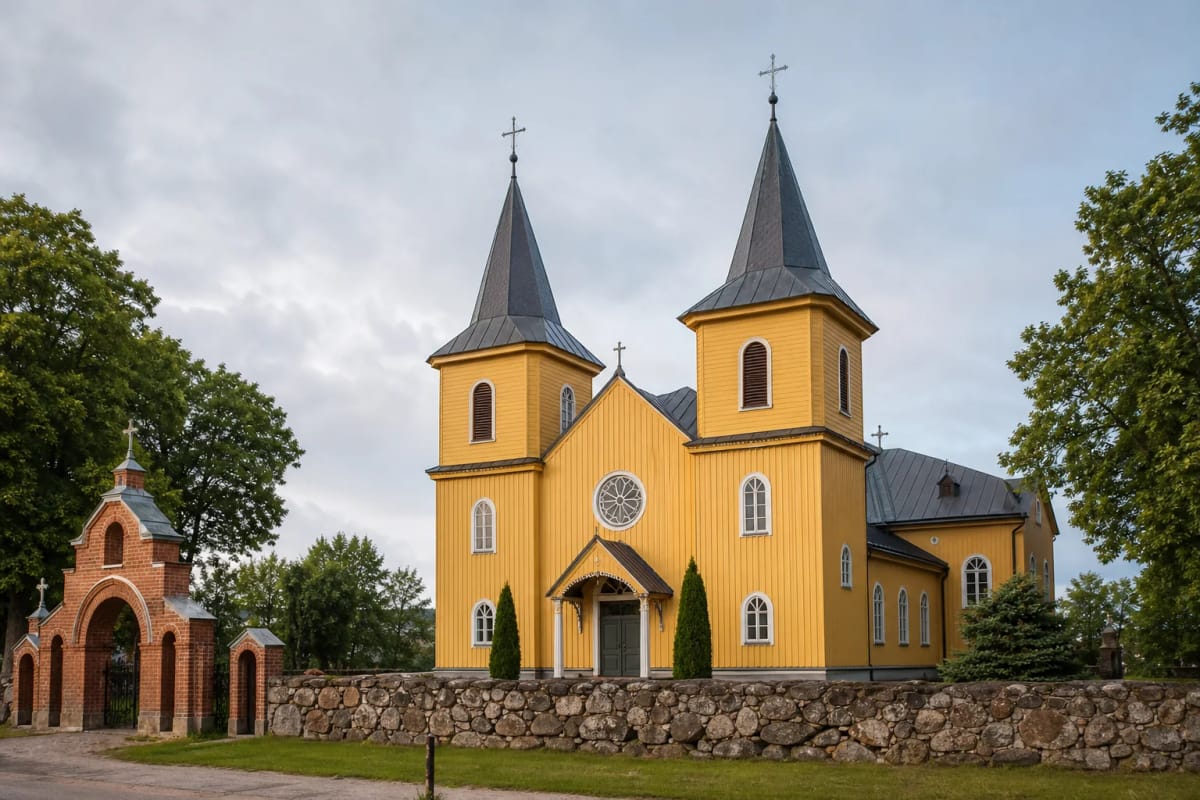
Tverai Church of the Visitation of the Blessed Virgin Mary stands in Tverai, Rietavas Municipality, in an old Samogitian centre. VLE and the Telšiai Diocese call it the largest wooden church in Lithuania. It is a two-towered, three-nave church: the foundations are masonry, the walls are log-built, and only the upper tower stages are wooden. Exact building dimensions are not given in the sources, so it is best to state the title itself rather than invent numbers.
VLE assigns the church to late 19th- and early 20th-century folk architecture with individual stylistic forms; the facades follow Neo-Gothic principles. Inside, a barrel vault covers the central nave, while the Baroque high altar is richly decorated with sculpture. Valuable 17th-19th-century paintings also survive in the church.
Tverai: an Old Samogitian Place
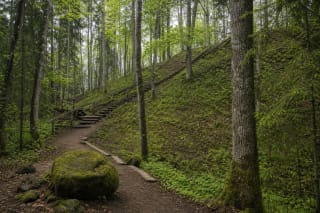
Tverai is one of the oldest places in Samogitia and is often called an old Samogitian capital. It was first mentioned in 1251 in the Hypatian Chronicle, in the account of Mindaugas' campaign against the Samogitian duke Vykintas. That year Mindaugas besieged Tverai Castle and was wounded. This early mention helps explain why an important religious centre developed here.
The first church in Tverai was built before the 1618 foundation, then burned and was rebuilt more than once. In 1748 the church was consecrated under the title of the Visitation of the Blessed Virgin Mary. According to VLE, construction of the current wooden church was permitted in 1897 and decoration was already underway that same year. It is the third or fourth church on this site.
Samogitian Baroque Gate and Belfry
The key feature of the Tverai ensemble is the churchyard fence and gate. VLE notes that the masonry churchyard fence was built in 1870 and renewed in 2004, and that it contains the only Samogitian Baroque-style churchyard gate in Lithuania. Fourteen Stations of the Cross are also built into the fence, making the enclosure itself a prayer route.
A separate belfry stands outside the churchyard. VLE dates it to 1907: the first storey is masonry and the second red brick. Nearby are two small chapels with ornamented crosses. Together these elements form the Tverai church building complex listed in the Register of Cultural Values.
Miraculous Marian Image and Pilgrimage
The high altar holds a revered image of the Mother of God. VLE identifies it as a Tikhvin Mother of God type, painted in tempera on wood and dated to the early 16th century; silvered coverings are mentioned already in the 1675-1677 visitation and are considered among the oldest of this type in Lithuania. This is documented art history.
A living devotional tradition is also attached to the image. It is said that Tverai official Elijas Ilgovskis brought it back from wars in Moscow, and that when the image became known for graces it was donated to the church; it is also said to have survived several fires. These stories are best understood as devotional tradition, not proven fact. A rare practice still survives here: walking around the high altar on one's knees with a lit candle.
Visiting and Indulgence Feasts
Tverai Church is an active parish church, so entry is free and visits are usually coordinated with service times. The main annual indulgence feasts are the Visitation of the Blessed Virgin Mary in early July and Žolinė, the Assumption, on 15 August; pilgrims come in large numbers at these times. Check parish or Telšiai Diocese information for current services and visiting arrangements.
Allow 30-60 minutes to see the church, Samogitian Baroque gate, Stations of the Cross, and belfry. Tverai is easy to combine with nearby Lopaičiai Hillfort and other Rietavas and Samogitian sites.