- Place
- Akademija, Akademija Eldership, Kaunas District Municipality
- Region
- Suvalkija
- Type
- a woodland nature trail inside Kamša State Botanical-Zoological Reserve
- Address
- Tako Street, Akademija, Kaunas District
- Coordinates
- 54.89675, 23.82706
- Visit duration
- 35-70 minutes for the short woodland circuit, longer when connecting with the Marvelė-Kačerginė cycle route
- Best time
- in daylight from spring to autumn; slopes, gravel, roots, and wooden steps may be slippery after rain
Kamša Reserve Nature Trail, Kamša Botanical-Zoological Reserve Nature Trail
1,189 m, 1,275 m, and about 1.5 km describe the route in three different ways
VLE's entry on Akademija records an installed 1,189 m nature trail connected to the Marvelė-Kačerginė cycle route. Kaunas District Municipality's 2024 register of transport infrastructure lists three Kamša Reserve trail segments separately: 78 m, 8 m, and 1,189 m. Their administrative total is 1,275 m.
Visitor information usually calls the walk an approximately 1.5 km circuit. That rounded outing may include approaches, connecting sections, or a different choice of start, but the sources checked do not explain the method. The three figures should therefore not be presented as three surveys of an identical line. For practical planning, expect a short walk of roughly 1.2-1.5 km and follow the route and signs found on site.
Google's coordinate 54.8967538, 23.8270554 belongs to the exact Kamša Nature Trail card, not to the centre of the entire 352 ha reserve. Saugoma.lt marks the wider protected area with the rounded point 54.895, 23.829. The pin on this page therefore identifies the trail site, but it is not labelled as an officially documented entrance, car park, or sole starting point.
The reserve established in 1960 is far larger than the visitor trail
Kamša State Botanical-Zoological Reserve was established on 27 September 1960. VSTT's assessment table gives its area as 352.1 ha, while Saugoma.lt rounds it to 352 ha. Of that area, 308.7 ha, or 87.7 per cent, forms part of a Natura 2000 site designated for habitat conservation.
Official descriptions phrase the purpose slightly differently. Saugoma.lt emphasises the protection of animals, rare plants, and their growing sites. The 2023 VSTT assessment refers to the complex of forest and meadow vegetation and sites of rare plants. Both formulations make the same practical point: protection applies to an ecological complex, not just the footpath or one veteran tree.
The reserve occupies the left bank of the Nemunas valley and crosses parts of both Kaunas city and Kaunas District. Akademija and Noreikiškės border it to the south, and Marvelė lies along its northern side. This page assigns the trail to Suvalkija because Akademija stands in Užnemunė, and VLE includes the left bank of the Nemunas and the southern part of Kaunas District within the Suvalkian area.
Ravines, slopes, and broadleaves create a complex valley forest rather than a city park
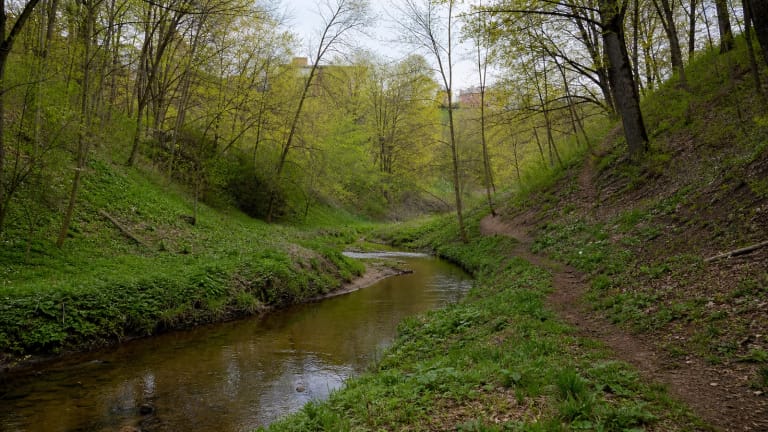
VSTT reports that forest covers 97 per cent of the reserve, while meadow and cultivated land account for only about 0.5 per cent. The Marvelė and Vėžpievis streams, both tributaries of the Nemunas, pass through the territory. Their valleys and smaller gullies break up the ground, bringing descents, climbs, and damp lower sections into a very short walk.
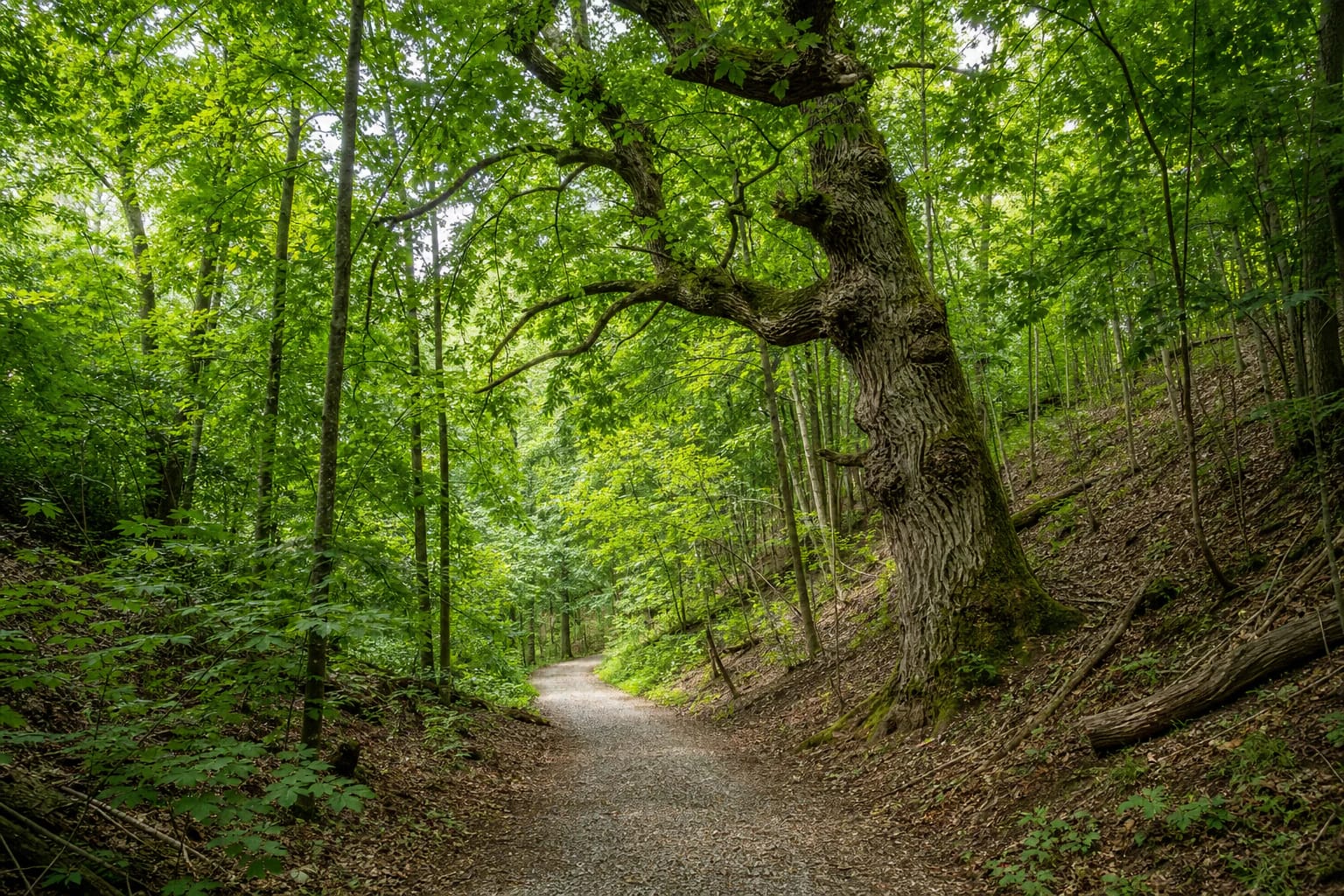
Within the forest stands, VSTT records 31 per cent dominated by linden, 8 per cent by aspen, and 7 per cent by black alder. That is not a complete list of every tree visible from the path. VSTT's official photograph of Kamša also shows a very old, spreading oak, but one photograph is not evidence that the whole reserve is an oakwood.
European habitat 9180, ravine and slope forests, explains why value here depends on more than tree age. Relief, changing moisture, shade, broadleaf composition, veteran trunks, and deadwood work together. A fallen or dying tree can be part of the protected habitat rather than a sign that the forest has been neglected.
The cinnabar flat bark beetle lives beneath bark, so searching must never damage its habitat
VSTT confirms the cinnabar flat bark beetle, Cucujus cinnaberinus, in Kamša Reserve. Lithuania's Red Data Book classifies the species as endangered and says the largest known Lithuanian populations occur in the Kamša and Jiesia reserves. This is a much more precise reason for the site's importance than a general promise that walkers will see rare wildlife.
The adult beetle is 11-15 mm long, black, with a red head, thorax, and wing cases. It develops beneath the bark of dead or dying broadleaves, especially elm, oak, poplar, and alder. Veteran trees, standing deadwood, fallen trunks, and large broken limbs can therefore remain important even when no visitor sees the beetle itself.
There is no reason to expect a sighting during an hour's walk. Peeling bark, turning over timber, or disturbing deadwood for a photograph would damage the very microhabitat that makes Kamša important. Read the interpretation boards and notice the many forms of broadleaf and dead wood instead; the reserve's signature species may remain hidden throughout the visit.
Urban growth and unmanaged runoff erode ravines, while garden waste is not forest compost
VSTT assessed Kamša Reserve's condition as satisfactory in 2023. Seven pressures were identified, most of low importance, but their range is characteristic of an urban fringe: woodland management, power lines, roads, construction, soil pollution, sport and leisure, tourism, and new infrastructure.
Increasing urbanisation and inadequately managed rainwater from some private housing areas in Noreikiškės may accelerate erosion in the reserve's ravines. VSTT also records dumped grass and other garden waste, the infilling of natural relief during construction, and isolated removal of wood for fuel. These are pressures documented specifically at Kamša, not a generic list for Lithuanian forests.
Visitors can avoid adding to them by remaining on the existing path, never cutting directly across a ravine slope, taking no timber, and leaving neither litter nor biodegradable garden waste. A heap of grass or leaves may look natural, but imported organic matter changes soil and vegetation just as surely as other material dumped inside the reserve.
Steps link the trail to the cycle route, but step-free access and a night-time regime are unconfirmed
VLE confirms that the nature trail connects with the Marvelė-Kačerginė cycle route. Visitor descriptions mention a gravel woodland path, interpretation boards, and a stepped descent towards the cycle route with a side channel for pushing a bicycle. That feature helps cyclists negotiate the stairs, but it does not make the trail step-free. No official source checked confirms wheelchair access throughout the route.
The official sources checked publish no dedicated ticket office, compulsory admission fee, or opening timetable for Kamša Nature Trail. Google displayed a 24-hour label, but that is not a reserve manager's safety recommendation and does not confirm lighting, winter maintenance, or uninterrupted passage. Plan a daylight visit and check official notices for temporary works or restrictions before travelling.
On 15 July 2026, the exact Google Maps card Kamša Nature Trail, place ID ChIJwTXUIcAh50YROzFMVFSl1Co, averaged 4.6 out of 5 from 571 reviews. It clears the 4.5 selection threshold, but both the score and review count can change. Conditions also need to be judged after storms, heavy rain, or frost, when roots, gravel, and wooden steps may be slippery.