

- Genre
- Wonder tale
- Source status
- traditional folklore
- Motifs
- dragon, nine heads, sister's courage, water boundary, rescue
The Sister and the Nine-Headed Dragon, The Nine-Headed Dragon
The tale
A family or kingdom is struck by misfortune: a nine-headed dragon appears by the water, forest, or road. It demands a sacrifice, blocks the way, or threatens the sister and brothers. Ordinary order no longer works, because the enemy is not human but monstrous.
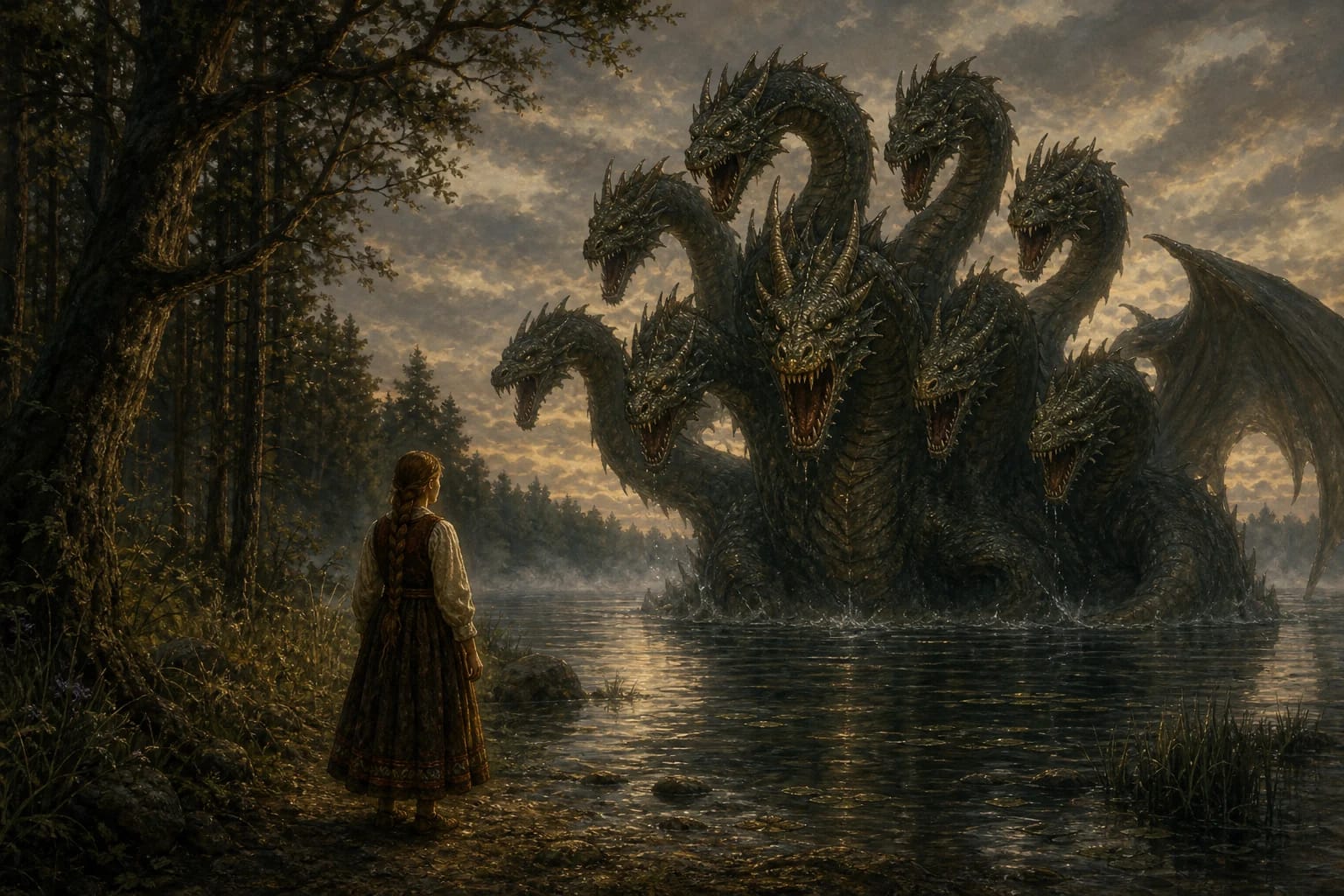
The sister finds herself in the most dangerous place. Sometimes she must be rescued; sometimes she herself helps a brother or hero defeat the dragon. The dragon's heads show not only strength but repeated danger: when one threat is cut away, another remains.
In the end the dragon is defeated, the victim is saved, and the family or community regains safety. Yet victory usually comes only after a trial requiring not only a sword, but loyalty, help, and the recognition of the right sign.
Interpretation
The dragon in the tale is concentrated danger. Nine heads allow the storyteller to enlarge the threat and show that evil is not easily removed.
The sister motif matters because the danger touches family bonds. The dragon is not only an external enemy: it tests whether brothers, sister, and helpers can act together.
Water or forest often works as a boundary between human life and chaos. When the dragon appears at such a boundary, the tale speaks about defending the order of the world.
History and variants
Dragon-fight plots are widely known, but in Lithuanian tales they combine with images of family, the sister, and local nature. The name of the nine-headed dragon may be the main identifying feature even when details change.
The defeat of a many-headed dragon belongs to the broad international field of dragon-slayer plots, in the Aarne-Thompson-Uther system especially ATU 300, "The Dragon-Slayer," and related rescue types. In Lithuanian wonder tales the dragon usually demands a sacrifice near water or a road, and a hero or brothers aided by a sister defeat it. Lithuanian variants are described in the catalogues of Jonas Balys (1936) and Bronislava Kerbelytė (1999-2002); the LLTI archive as a whole preserves more than 30,000 Lithuanian tale variants.
No creation date can be given. This is a variant tale whose aim is not to record a historical event but to transmit a model for confronting extraordinary danger.
What visitors can take away
The tale helps explain why the slibinas, often translated as dragon, is more than a monster in Lithuanian folklore. It marks a broken boundary, communal fear, and a trial that requires people to act together.