
- Genre
- Lagoon-coast legend
- Source status
- local legend and landscape of Lithuania Minor
- Motifs
- giant, Curonian Lagoon, birds, cape, lagoon coast
Ventė Cape, Ventė peninsula, Cape of Ventė
The Legend of Ventė Cape
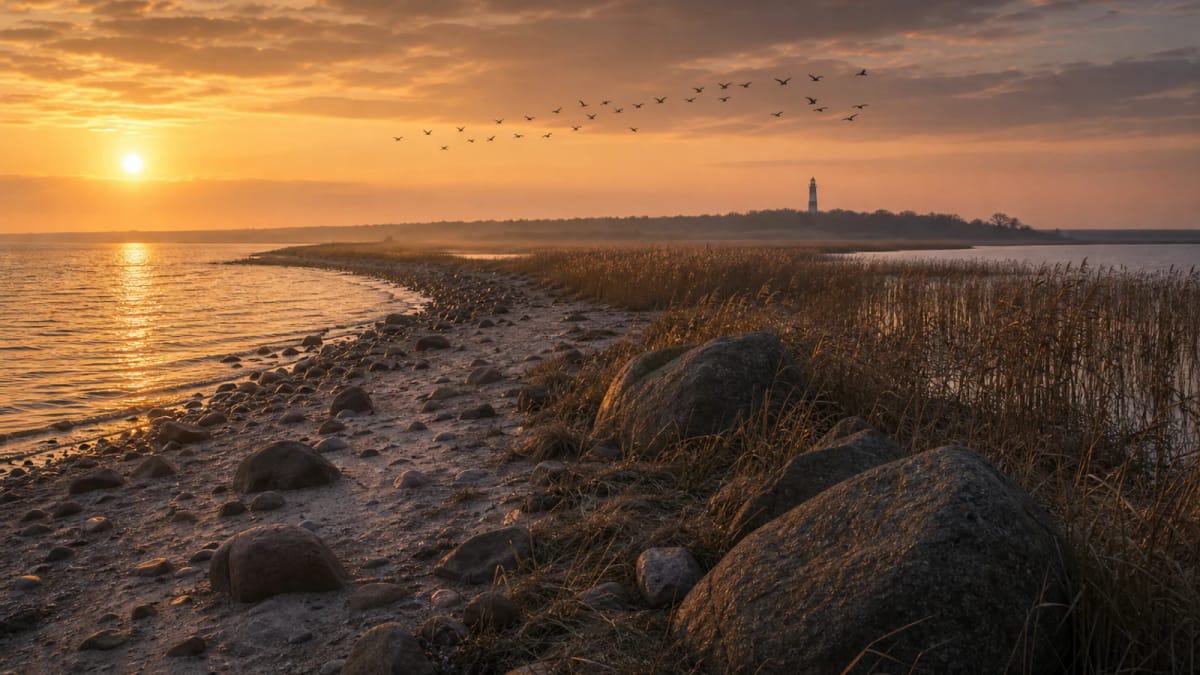
In lagoon-coast stories, Ventė Cape is explained as a place where a giant, walking through the lagoon or carrying earth, spilled part of his burden. Sand, stones, and soil fell into a long projection like a finger pointing into the Curonian Lagoon.

The wind never falls silent here, and water on both sides reminds visitors that the cape is a boundary place. People said that such land could not have been shaped by ordinary everyday work; it must have been touched by enormous force.
Later Ventė Cape became a marker on the birds' route, a place of a lighthouse and an ornithological station. But in the legend it is first of all a story about the origin of a lagoon-coast landscape.
Interpretation of the Ventė Cape Legend
The form of the cape itself invites legend. A peninsula extending into the lagoon looks like a deliberately left sign, so the motif of earth scattered by a giant explains its unusual geometry.
In lagoon-coast legends, change is often important: water floods, wind blows sand, and shores shift. In this imagination, Ventė Cape becomes a piece of land holding its place between two elements.
Today it is most often recognized through bird migration, but the legend recalls an earlier way of seeing: when a person first asks why the land entered the water here in such a strange way.
History of the Ventė Cape Legend
VLE describes Ventė Cape as a peninsula of the Curonian Lagoon, formed through land subsidence and moraine formations flooded by lagoon water. The Encyclopedia of Lithuania Minor provides regional geographical context.
Local-tradition sources mention legends about lands or stones scattered by a giant. They fit the broader field of lagoon-coast stories, where the Curonian Spit, the lagoon, and capes are explained through the work of giants.
The Ventė Cape page therefore deliberately joins legendary origin imagery with a real geological and historical landscape.
Ventė Cape is known worldwide for its ornithological station, founded in 1929 and one of the oldest bird-ringing stations in Europe, as well as for its lighthouse. The motif of earth scattered by a giant to explain the cape's shape belongs to lagoon-coast etiological legends. Lithuanian place legends are collected in Žemės atmintis: Lietuvių liaudies padavimai (1999) and classified in Bronislava Kerbelytė's catalogue, vol. 3 (2002).