
- Genre
- Cave and spring legend
- Source status
- local tradition and geological monument
- Motifs
- cave, spring, Neris, holy place, conglomerate rock
Liucionys Cave, Skališkės rock, Holy Cave
The Legend of Skališkės Cave
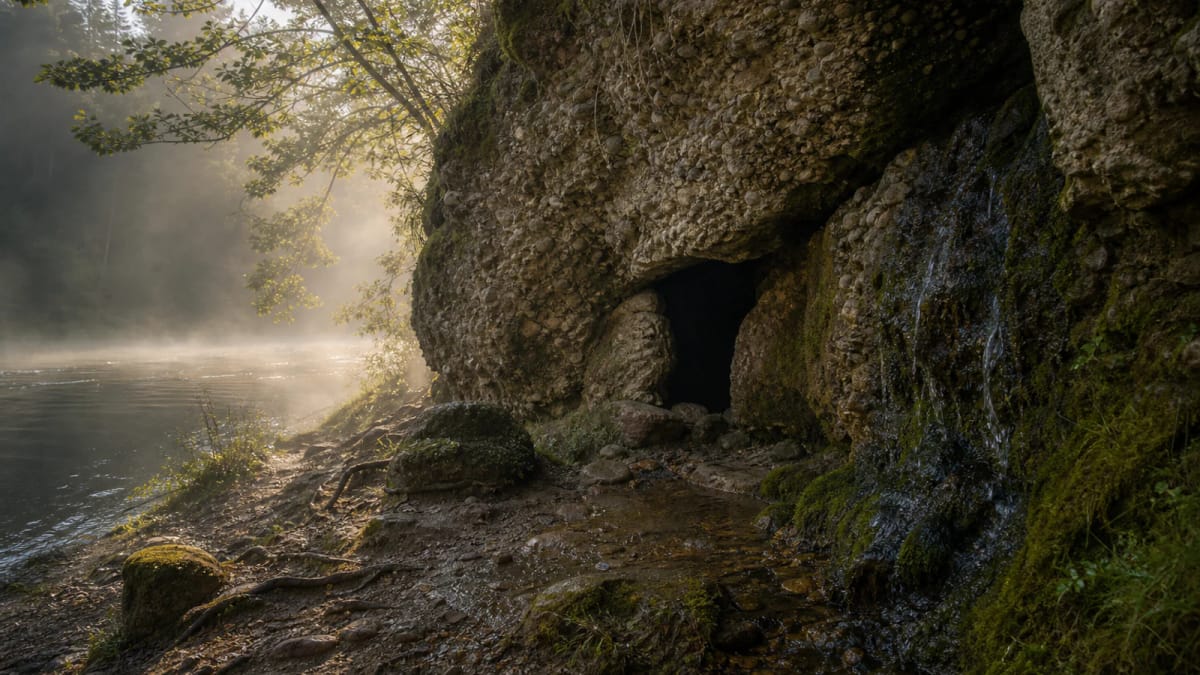
By the Neris people tell of a cave called not only Skališkės or Liucionys, but also Holy Cave. It opens in a forest ravine, and water drips from the rock as if the earth itself were speaking slowly here.
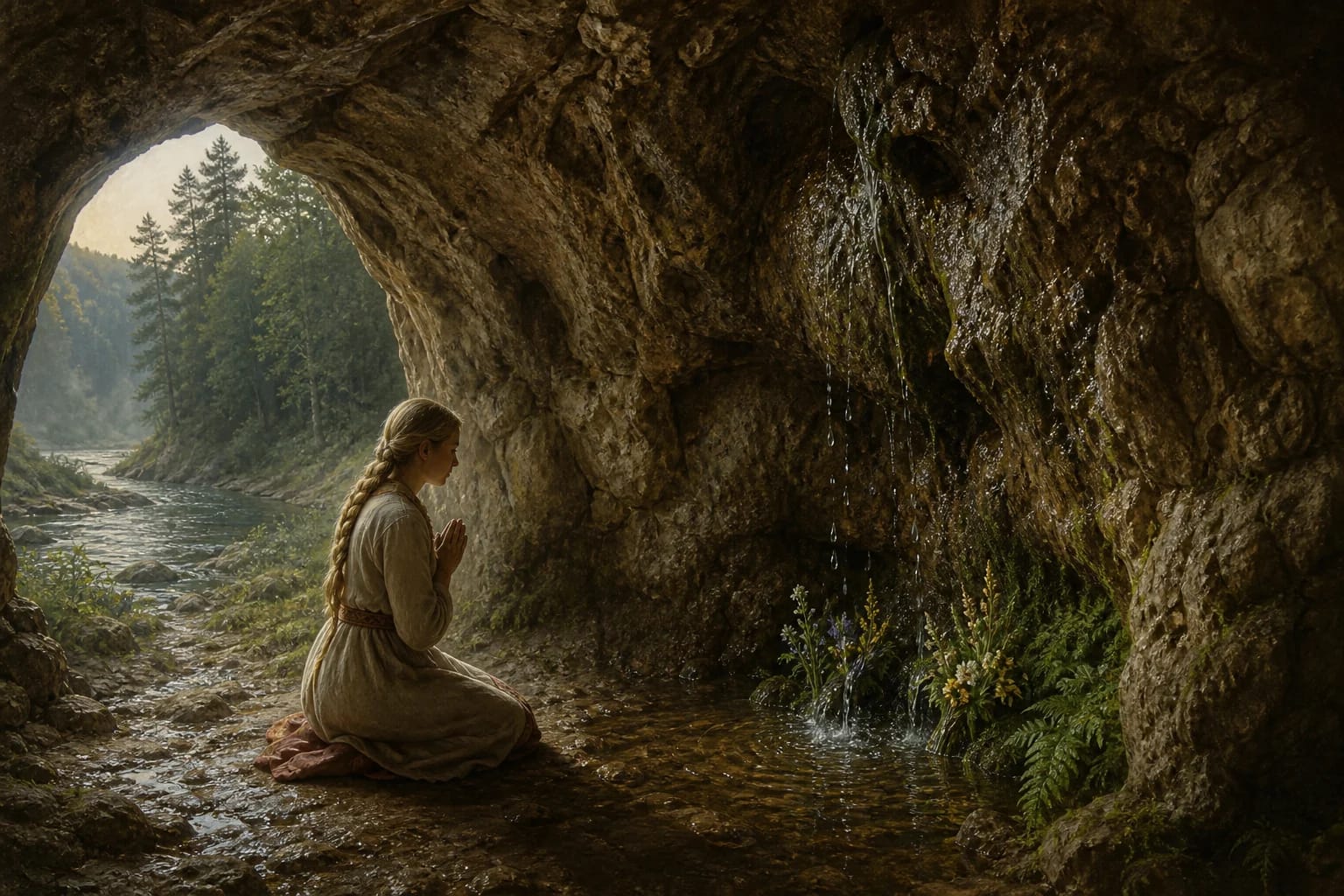
Older visitors would say that one must behave quietly near such a place: do not disturb the spring, break the rock, or laugh at what you do not understand. Water, stone, and dark opening guard their boundary.
The legend of Skališkės Cave is not loud. It has no king and no battle. Its strength lies in the intuition of sacredness: the cave seems like a threshold where water comes from inside the earth to the surface.
Interpretation of the Skališkės Cave Legend
In cave legends the boundary matters. One can look in, but does not always want to enter; one can listen to the water, but should not turn it into mere amusement. Such a place naturally gains a language of prohibitions and respect.
Skališkės Cave joins three strong elements: river, stone, and spring. In folkloric imagination such a combination often means a living landscape not fully controlled by humans.
The name Holy Cave shows that the place was understood as more than a geological object. Even if the details of old rites are unclear, the name preserves a trace of reverence.
History of the Skališkės Cave Legend
VLE presents Skališkės rock as a geological monument with a cave formed in its lower part. Sources also mention water dripping from the rock and the environment of the right bank of the Neris.
In local and tourism descriptions, Skališkės Cave is called Liucionys Cave, Holy Cave, rock, or outcrop. This variety of names shows that the object was seen from different angles of local memory.
This page therefore tells not only about one plot but about the legendary aura of a place that grows out of names, water, and the threshold form of the cave.
Skališkės, Liucionys, or Holy Cave is a rare combination of conglomerate outcrop, cave, and spring on the right bank of the Neris, protected as a geological monument; the name Holy Cave bears witness to a tradition of sacredness. Lithuanian place legends are collected in Žemės atmintis: Lietuvių liaudies padavimai (1999) and classified in Bronislava Kerbelytė's catalogue, vol. 3 (2002).