
- Genre
- Stone legend
- Source status
- local tradition of a mythological stone
- Motifs
- son of the wind, sleeping beneath a stone, kūlgrinda, altar, marsh
Great Kūlis, Šilalė Stone, Šilalė Kūlis
The Legend of Šilalė Kūlis
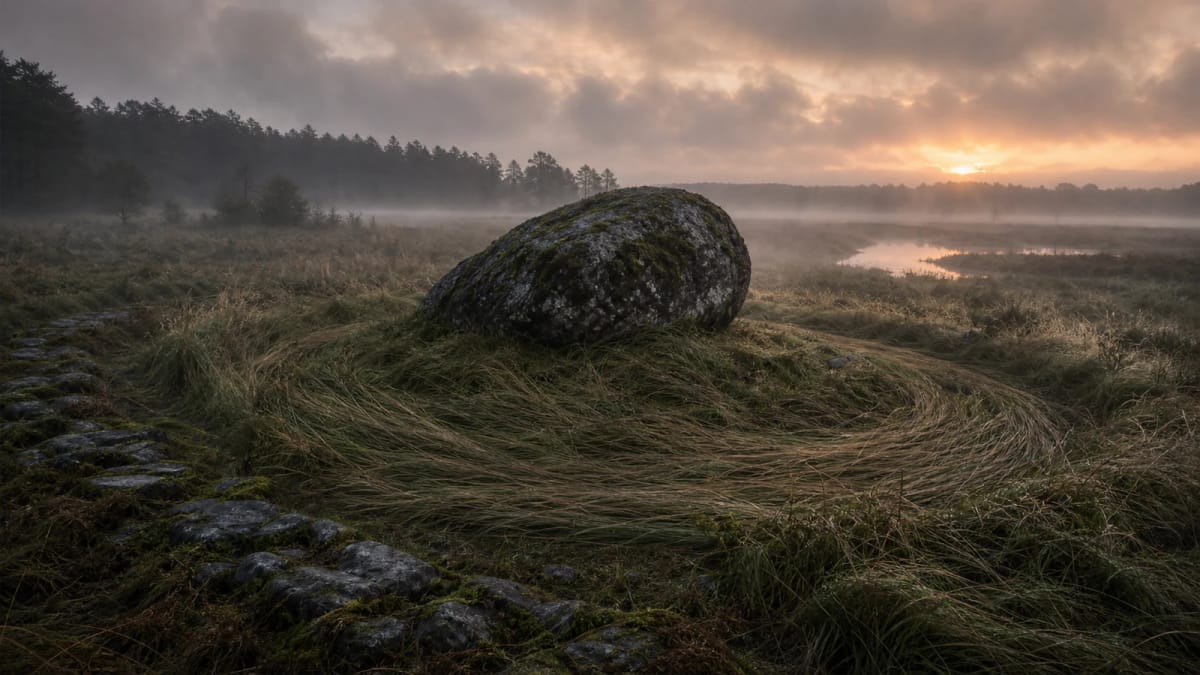
Žemaitians tell that the son of the wind sleeps beneath Šilalė Kūlis. The great stone lies on a small rise once surrounded by marshes, so it seemed like an islet in wet ground.
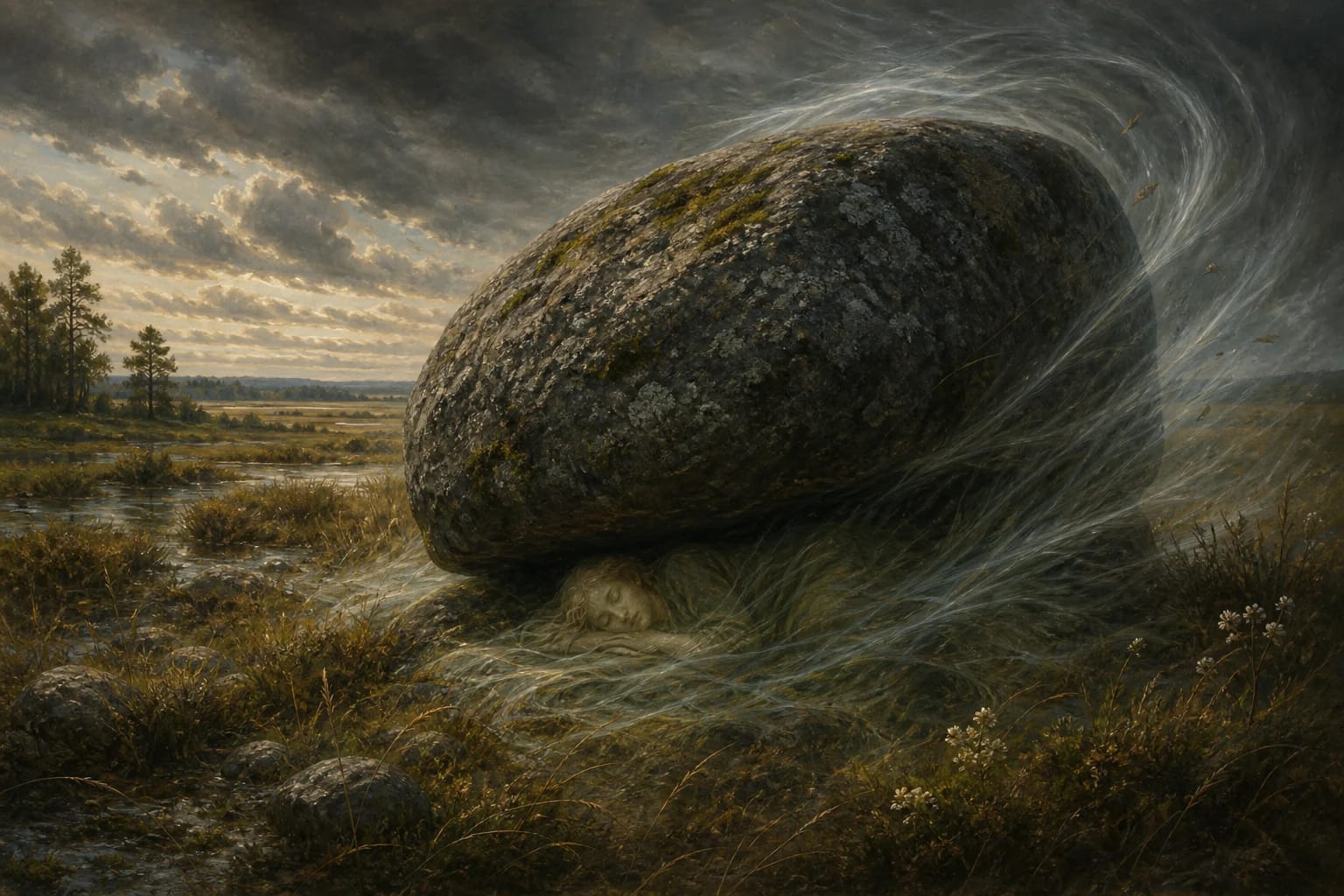
Whoever behaves disrespectfully near the kūlis disturbs not an ordinary stone but a sleeping force. The son of the wind may wake, and once awake he may release winds, unsettle the weather, and remind people that a sacred place cannot be treated as a mere object.
Nearby bowl stones, an altar, and a kūlgrinda, or stone causeway through wet ground, are also mentioned. The legend of Šilalė Kūlis therefore speaks about a whole small world of sacred place, not only about one boulder.
Interpretation of the Šilalė Kūlis Legend
The sleeping son of the wind is a motif of personified nature. Wind becomes not air but a being whose power is temporarily closed beneath a stone.
The marshes and the kūlgrinda matter in the legend as a boundary of approach. One reaches the sacred place not just any way, but by a road of stones, so the journey itself becomes an act of respect.
The bowl stones and the memory of an altar allow this legend to be read as an explanation of local sacredness, not simply as an amusing story about wind.
History of the Šilalė Kūlis Legend
VLE and protected-territory sources mention Šilalė Kūlis as a large mythological stone. Saugoma.lt and the heritage guide clearly give the legend of the son of the wind sleeping beneath the stone.
The kūlgrinda, bowl stone, and altar stone mentioned nearby strengthen the interpretation of the place as a sanctuary rather than only a boulder.
For that reason, the Šilalė Kūlis page should be written as a legend of stone and ritual landscape, not merely as a description of a large erratic.
In Žemaitian, kūlis means stone. The nearby bowl stones, altar stones, and kūlgrinda show that this is a legend of an old sacred place, not simply a description of a boulder. Lithuanian place legends are collected in Žemės atmintis: Lietuvių liaudies padavimai (1999) and classified in Bronislava Kerbelytė's catalogue, vol. 3 (2002).