
- Genre
- Sacred-site and hillfort legends
- Source status
- regional local tradition
- Motifs
- Lopaičiai, Tverai, sacred site, mythological stones, spring, priests
Lopaičiai legends, Lopaičiai mythological complex, Tverai Lopaičiai
The Legends of Lopaičiai Hillfort
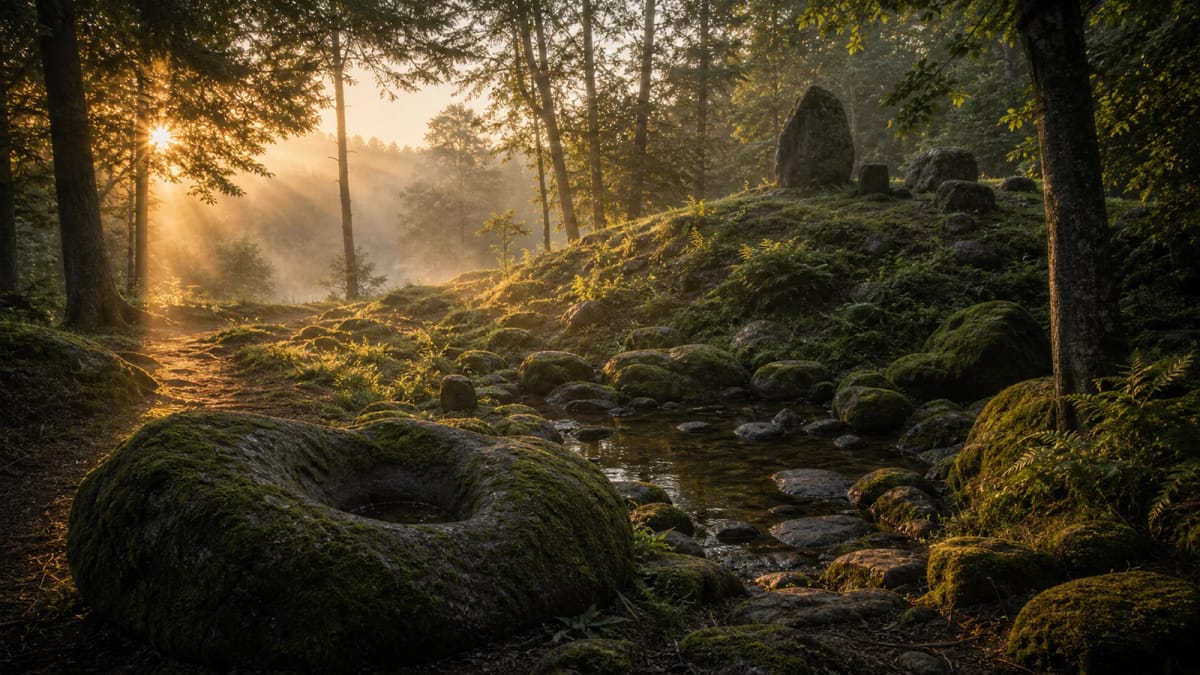
Lopaičiai is told not as one closed event, but as a place where every stone and spring has its own voice. Some stop by the great stone and make a wish, others look for the fertility stone, and still others go to the spring whose water is credited with special power.
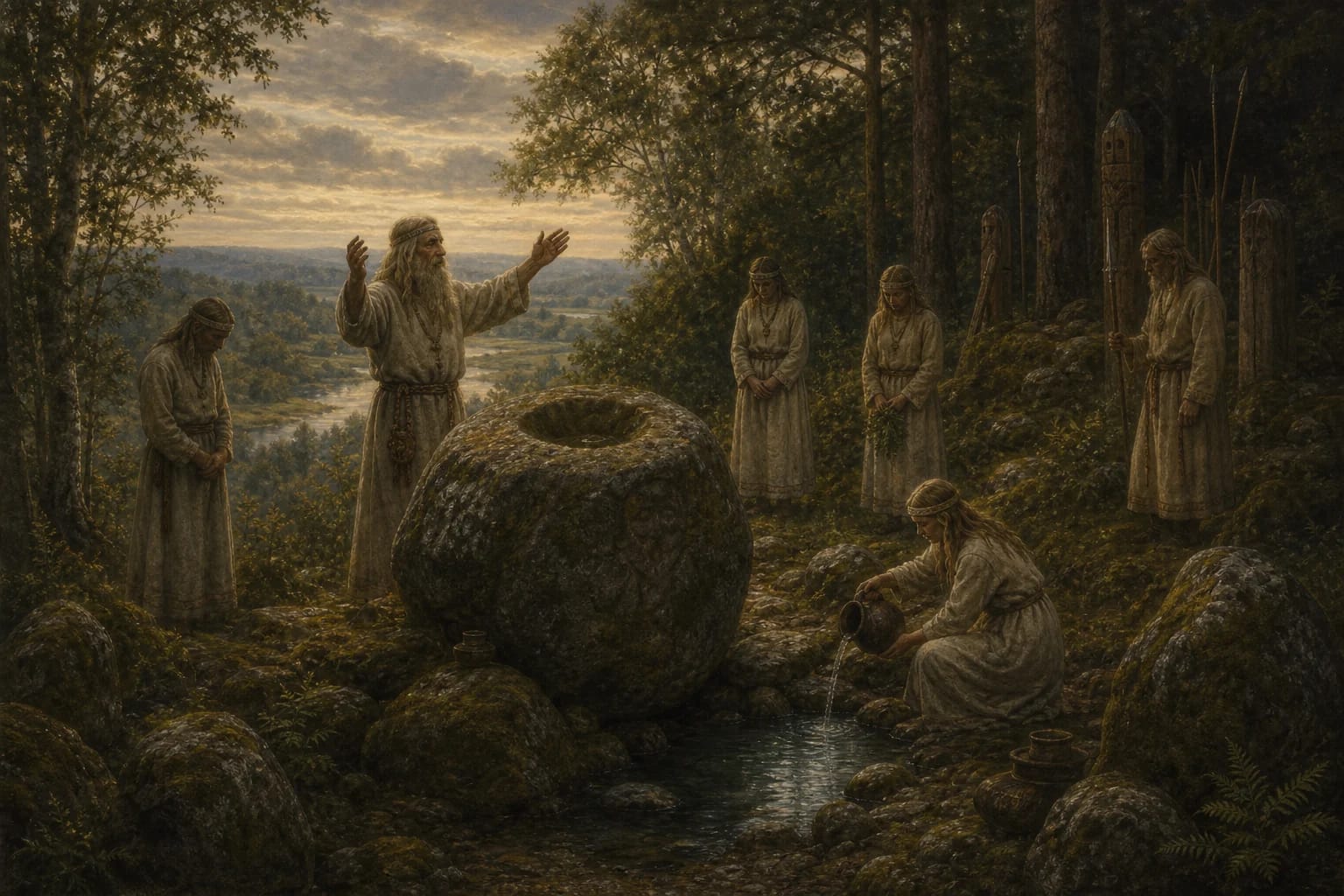
At the center of the legends stands the hill and its surroundings. People say there may have been an old Samogitian sacred site here, a place of priests where signs of the sky were observed, seasons were discussed, and the signs of water and stone were heard.
The Lopaičiai legends do not rely on one castle battle. They are more like a local whisper: the stone becomes a place of request, the spring a sign of purification, and the hill an old center of decisions and mystery.
Interpreting the Lopaičiai Hillfort Legends
The Lopaičiai tradition shows how a place legend can divide into many small stories. There is no single character who explains everything. The place is explained by stone names, the reputation of springs, paths, hills, and human actions.
In such places, the boundary between respectful local memory and overconfident claims matters. One can speak of the intuition of a sacred site, regional tradition, and people's belief in the power of stones or water, but every story should not be presented as archaeological fact.
In the legends, Lopaičiai becomes a place for listening to the Samogitian landscape. A person does not so much conquer the hill as try to make terms with it: leave a pebble, drink water, pass quietly along the path.
History of the Lopaičiai Hillfort Legends
Rietavas tourism sources present Lopaičiai as a complex of hillfort, supposed sacred site, stones, springs, and other archaeological and natural objects. In modern local memory it is associated with mystery, priestly domains, and healing or wish-granting motifs.
Folklore and contemporary landscape studies discuss Lopaičiai as a place where older legends, modern interpretations, and tourism language intertwine very densely. That matters because this page speaks of the layer of legends, not of confirming every claim.
For that reason, the Lopaičiai page deliberately remains story-first: it tells how the place works on people's imagination and only then separates the layers of history, research, and modern visiting.
Lopaičiai is a complex of hillfort and possible old sacred site with a healing spring. Such legends about the power of stones, springs, and hills belong to local, or toponymic, place legends. Lithuanian place legends were collected in Žemės atmintis: Lietuvių liaudies padavimai (1999) and classified in Bronislava Kerbelytė's catalogue (Lietuvių pasakojamosios tautosakos katalogas), volume 3 (2002).
Why Lopaičiai Has So Many Stories
Many stories arise where the landscape is dense: hill, springs, stones, hollows, and paths make a place where signs are easy to perceive. Lopaičiai is exactly such a place.
Another factor is human behavior. When visitors repeat actions by a stone or spring, the story does not stop. It is made again with every visit.