
- Genre
- Sacred-hill legend
- Source status
- regional local tradition
- Motifs
- Lada, sacred hill, offerings, six lakes, Aukštaitija, panorama
Ladakalnis, Ledakalnis, Lada Hill legend
The Legend of Ladakalnis
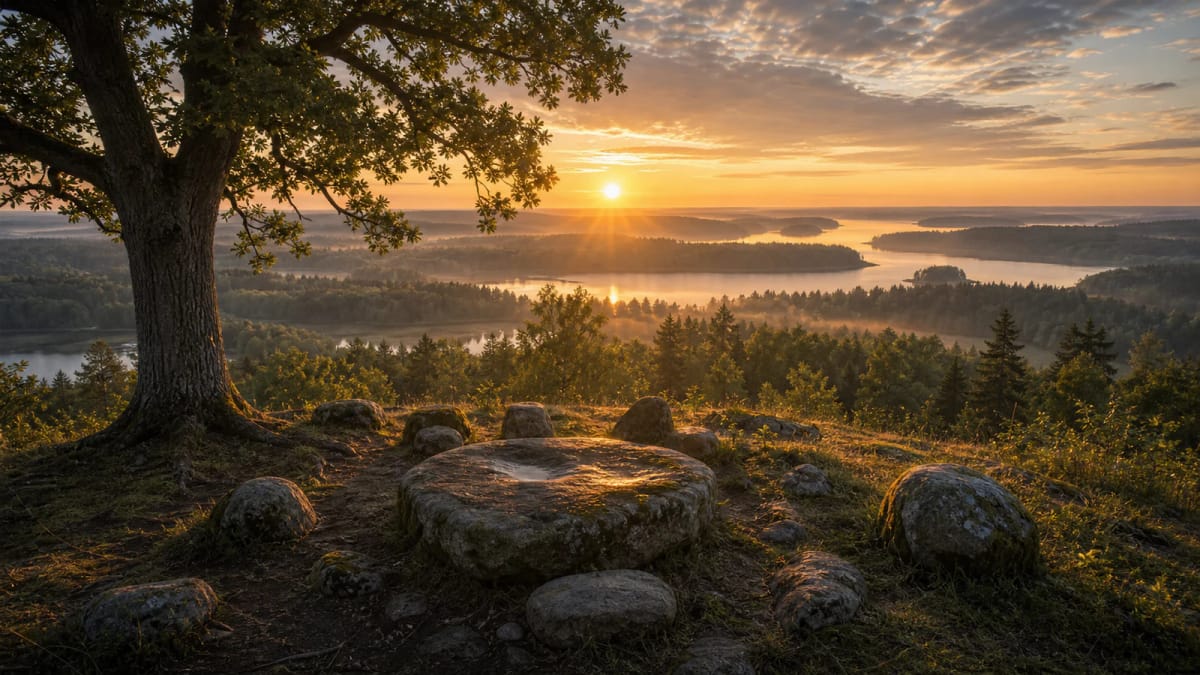
It is said that Ladakalnis was from old times a high place from which a person saw not only the surroundings but a wider circle of the world. Lakes shine around the hill, so the summit seemed suited to speaking with sky, water, and earth.
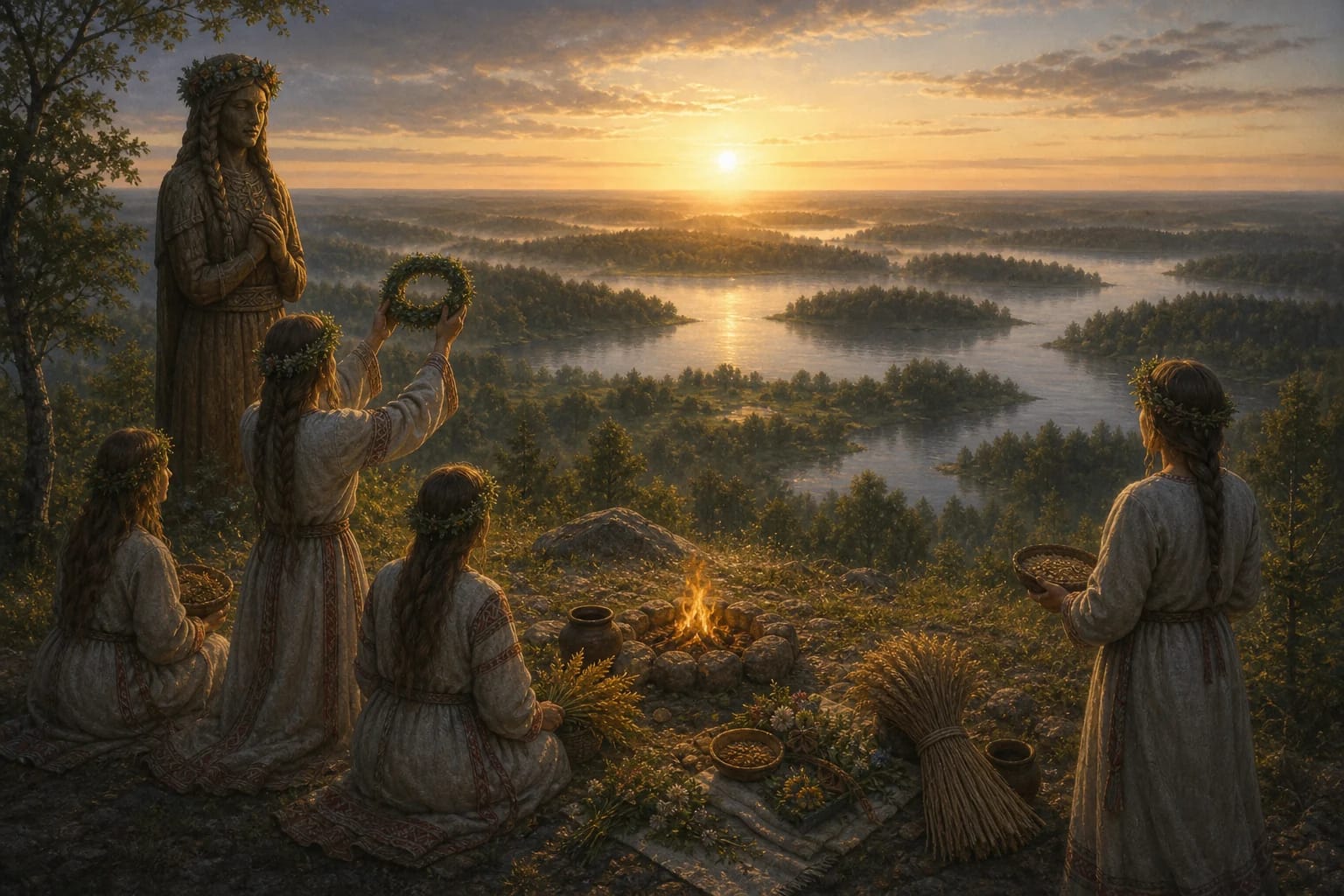
Local tradition connects the hill with Lada, the Great Mother. Offerings were supposedly made on the hill, asking for harvest, life, health, and household good fortune. A person came to the summit not to take, but to leave: a word, request, offering, or silence.
When mist rose from the lakes, the hill looked like an island above water. In the legend, therefore, Ladakalnis is not only a viewpoint. It is a sacred hill where the landscape itself creates the feeling of ritual.
Interpreting the Ladakalnis Legend
The Ladakalnis legend rests on the relationship between height and water. The hill lifts a person above everyday life, while the surrounding lakes create an impression of enclosure and vitality. This combination fits images of mother, fertility, and offering well.
The Lada motif must be presented carefully. It matters to regional tradition and modern explanations of the place, but reconstructions of old religion are not always equally strong in the sources. The legend remains local memory, not a simple protocol of rituals.
The panorama of six lakes helps explain why Ladakalnis became exceptional. In the story, seeing is almost a ritual: to see many lakes means to see the region as one living whole.
History of the Ladakalnis Legend
Protected-area sources present Ladakalnis as a well-known place in Aukštaitija National Park, a 176-meter hill from which six lakes can be seen. They also mention the tradition of connecting the hill with offerings to the goddess Lada.
Ladakalnis is a geomorphological natural monument, so its significance is not only narrative. The shape of the place, the network of lakes, and the national-park setting form a real basis that makes the legend feel attached to a concrete landscape.
Baltic Road material notes that explanations of the place name are not unambiguous. That is useful: it allows the Lada motif to be told without making it the only possible origin explanation.
It is important to note that the goddess Lada is disputed and largely a Romantic-era reconstruction; she is not attested in reliable early sources, so scholars treat the name cautiously. In genre terms, this is a sacred-hill or place legend. Lithuanian place legends were collected in Žemės atmintis: Lietuvių liaudies padavimai (1999) and classified in Bronislava Kerbelytė's catalogue, volume 3 (2002).
Why Ladakalnis Feels Sacred
The feeling of holiness is created not only by texts. It is created by the path upward, the ring of lakes, silence, open sky, and the sense that at the summit a person stands between several parts of the world.
For that reason, the Ladakalnis legend can be read as a landscape experience. It explains not only what people said about the hill, but also why such a hill invited stories in the first place.