- Category
- Harvest and Perkūnas Animals
- Domain
- Perkūnas, thunder, sacrifice, fertility, harvest, Užgavėnės, masks, transformation
- Source status
- folkloric
she-goat, Perkūnas' goat, little goat, kid
What does the goat mean?
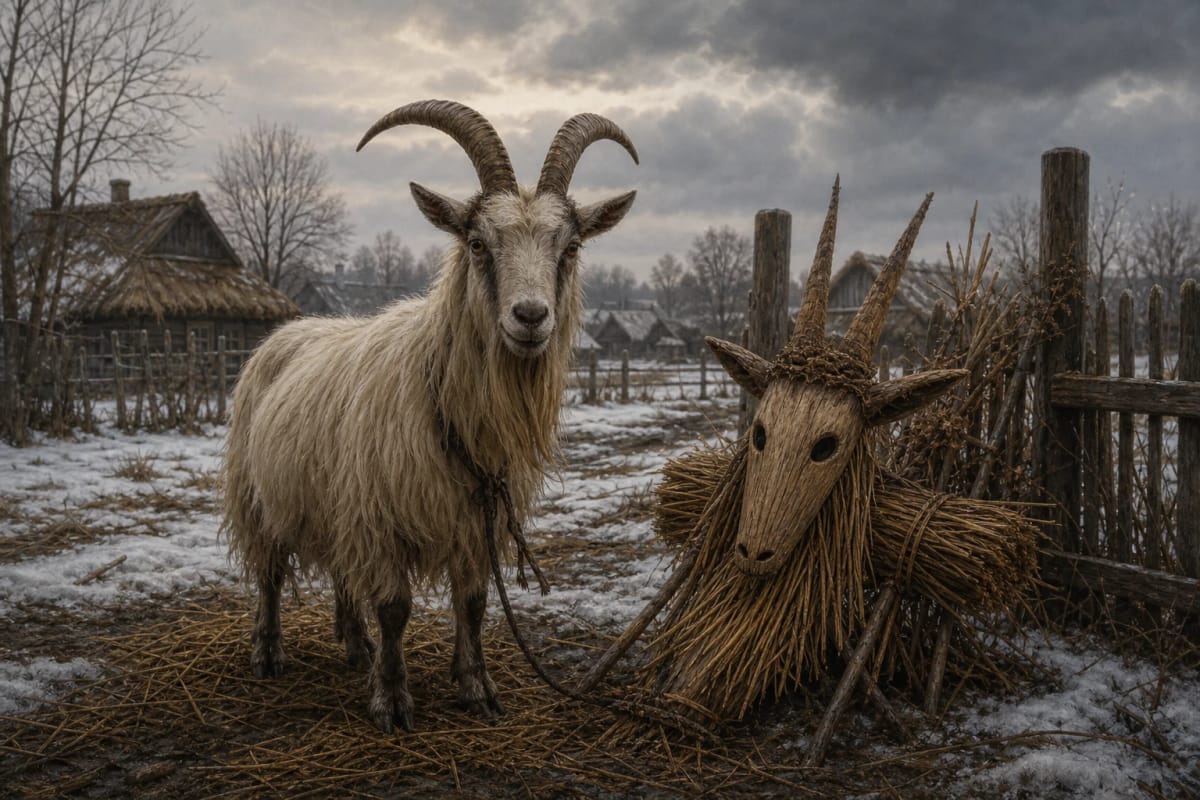
In Lithuanian folklore the goat is a domestic herd animal, but its symbolism reaches well beyond everyday farming. It is connected with Perkūnas, fertility and harvest, and winter-ending calendar rites, especially Užgavėnės.
Unlike wild forest beasts, the goat belongs to the human world, so it often becomes an animal of sacrifice or ritual performance. Through it the old community spoke about renewal of life, strength, and the dual nature of a domesticated yet stubborn animal principle.
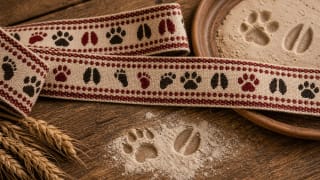
It is important not to confuse the animal goat with the woven ožkanagučiai pattern. In ornament the topic is the goat's hoofprint in bands and textiles; here the subject is the mythical animal itself and its place in beliefs.
The goat and Perkūnas
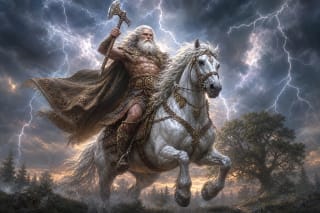
The clearest mythological connection of the goat is with Perkūnas, the god of sky and thunder. Legends say that Perkūnas drives across the sky in a two-wheeled cart harnessed with horses or goats, and the rumbling of its iron wheels causes thunder.
This pairing with the thunder god shows that the animal was not understood only as a farm creature. It is written into an image of heavenly forces, where the goat helps set the thunderstorm in motion, raising a common herd animal to a mythic level.
The goat's connection with vegetation and abundance fits Perkūnas' fertility powers of rain, storm, and harvest-awakening force, so the two images strengthen each other.
Sacrifice and harvest rites
In Baltic and Lithuanian ritual practice animal sacrifice was an important form of communication with the gods, and the goat was one suitable sacrificial animal. The old religion offered domestic animals to gods in hopes of harvest, herd increase, and protection.
In such rites the goat's blood and meat were understood as a gift joining the human world with heavenly powers. Through sacrifice the community gave back a share of life to the force from which it expected new harvest and fertility.
This sacrificial layer explains why the goat so easily moves from farm to rite: it is valuable enough to be a meaningful gift, yet common enough to be present in almost every yard.
The goat at Užgavėnės
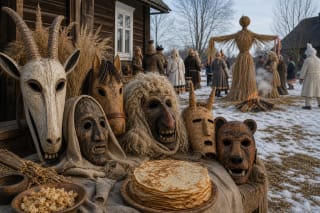
In the folk calendar the goat appears most vividly at Užgavėnės, the festival of driving out winter and awaiting spring. Among mummers' masks the goat is one of the most common animal masks, beside bear, crane, horse, and devil.

The 'death and revival' motif is important in the Užgavėnės goat performance: the goat pretends to fall dead and then comes back to life. This play is understood as a sign of the renewal of vegetation and life. Winter ends, and nature awakens again.
Leading the goat and its mischief have both comic and ritual meaning: noise, masks, and performance were meant to help drive out winter and call forth a fertile spring.
Fertility, strength, and stubbornness
In folk imagery the goat is linked with masculine force, vitality, and fertility, an animal that produces abundant offspring. It therefore naturally entered the symbolism of harvest and plenty.
At the same time the goat carries a shade of stubbornness and restlessness. In folk speech and proverbs it is often shown as capricious and difficult to control. This fits its partly wild feeling, even though it is a domestic animal.
This duality, useful and fertile yet stubborn, allows the goat to be both a good sacrificial animal and a comic Užgavėnės character at the same time.
The goat, the devil, and the world of masks
Through its horns, beard, and stubborn nature, folk imagery sometimes brings the goat close to the devil and the world of masks. In legends the devil is shown with horns and hooves, and the goat is an animal of horns and hooves, so a formal resemblance appears.
Still, in Lithuanian folklore the goat is not simply 'devilish'. It remains first of all an animal of the herd, sacrifice, and Užgavėnės; the devilish shade is only one layer of its ambiguity.
This very ambiguity, between heavenly Perkūnas and earthly masked laughter, makes the goat a rich folklore symbol rather than a flat image.
How should the goat be read today?
Today the goat is best explained as a symbol with several layers: it is an animal of Perkūnas, a sacrificial gift, an Užgavėnės mask, and a fertility sign. None of these meanings alone reveals the whole image.
It is useful to see the goat together with Perkūnas, Užgavėnės mummers, and harvest rites. Then it becomes a living image of calendar and mythic tradition. The goat-hoof pattern should be treated as a separate ornament topic, even though both are tied to the same animal.