- Category
- Legend beings
- Domain
- Place legends, landscape, hills, stones, hillforts, ancient time
- Source status
- folklore
Who are giants in Lithuanian place legends?
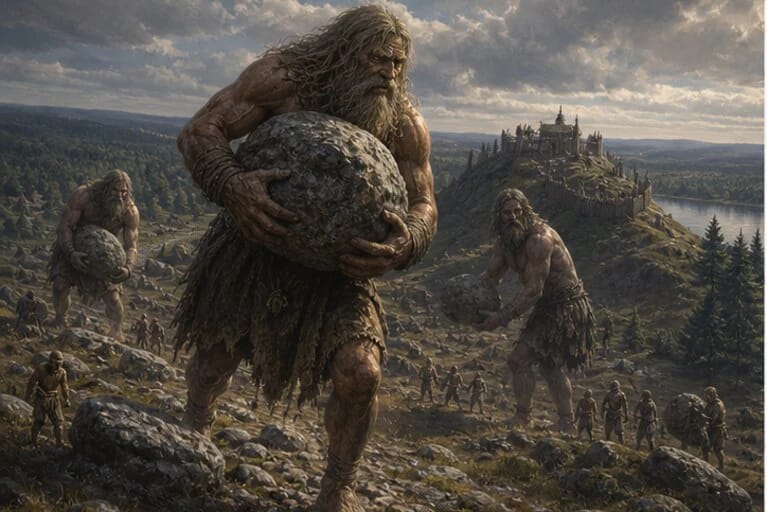
Giants are beings of extraordinary size in place legends. In Lithuanian landscape stories they often explain how stones, hills, hillforts, lakes, or other unusual places came to be.
A giant is not simply a large human being. He or she belongs to an old, almost primordial time when the form of the world could still be changed by immense force.
Sources for giants: place legends and local memory
Giants live first of all in padavimai, place legends that explain the origin of sites, hills, stones, lakes, or buildings. Such stories preserve not only mythology, but local memory.
For that reason giants are closely tied to the Lithuanian landscape. They help people see that a stone or hillfort is not only a geographical object, but also a place of story.
Giants and stones
Stones are among the most common traces of giants. A large boulder may be explained as a stone thrown, carried, dropped, or marked by a giant.
Such stories help explain how unusual natural objects are drawn into cultural memory. The giant gives the stone a story.
Giants, hillforts, and hills
Giants may be connected with hillforts, hills, and large landforms. Their size explains the scale of the landscape: what seems impossible to humans becomes an action for a giant.
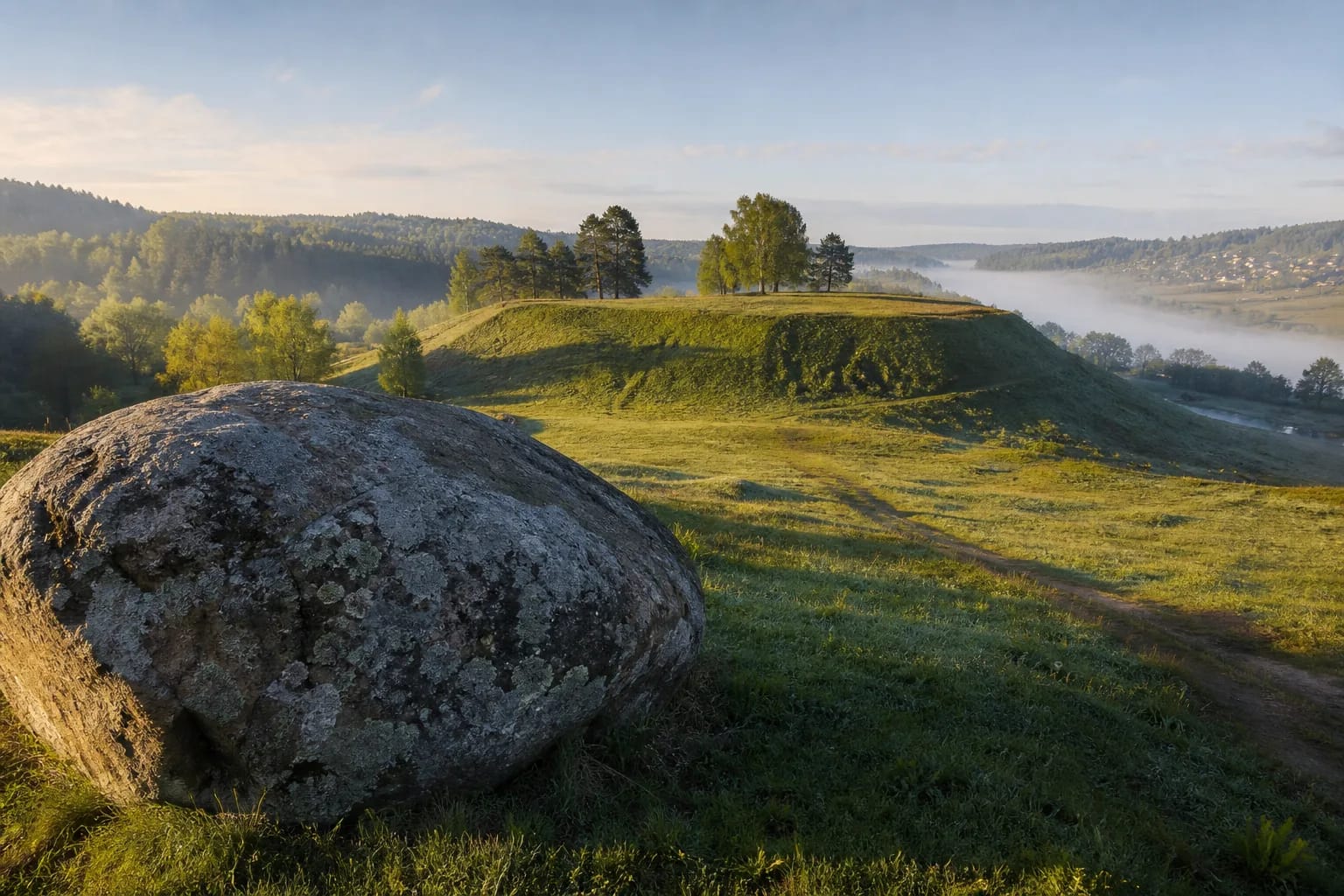
In legends about hillforts and hills, giants often bring together history, mythology, and local identity. The most famous such giantess is Neringa: according to legend, the good giantess piled up the Curonian Spit to protect fishermen from the stormy sea. Large burial mounds and graves are also connected with giants and are popularly called milžinkapiai, giants' graves.
The time of giants
Giants usually belong to antiquity: a time before the present order or at its beginning. That allows them to act as shapers of the world.
This motif of 'old times' helps distinguish giants from everyday legend beings. They are part of an epic imagination that explains the landscape.
Giants today
Today giant stories are a bridge between mythology and Lithuanian places to visit. They naturally connect with hillforts, stones, place legends, and regional stories.
Specific places, specific stones, and the giant legends attached to them help readers see the landscape as a text of cultural memory.