
I Fed My Little Horse lyrics and meaning
Aš užaugau pas tėvelį,
Nusišėriau sau žirgelį.
Nusišėriau sau žirgelį,
Kad ir mažą, bile gražų.
Šile žirgus ganydamas,
Aukso pančiais pančiodamas.
Aukso pančiais pančiodamas,
Šilkų dekiais dekiuodamas.
Lygioms lankoms raitas josiu,
Nemunėliu plaukte plauksiu.
Nemunėliu plaukte plauksiu,
Per Nerelę nerte nersiu.
Per Nerelę nerte nersiu,
Prieš kalnelį tik šuoleliu.
View illustration
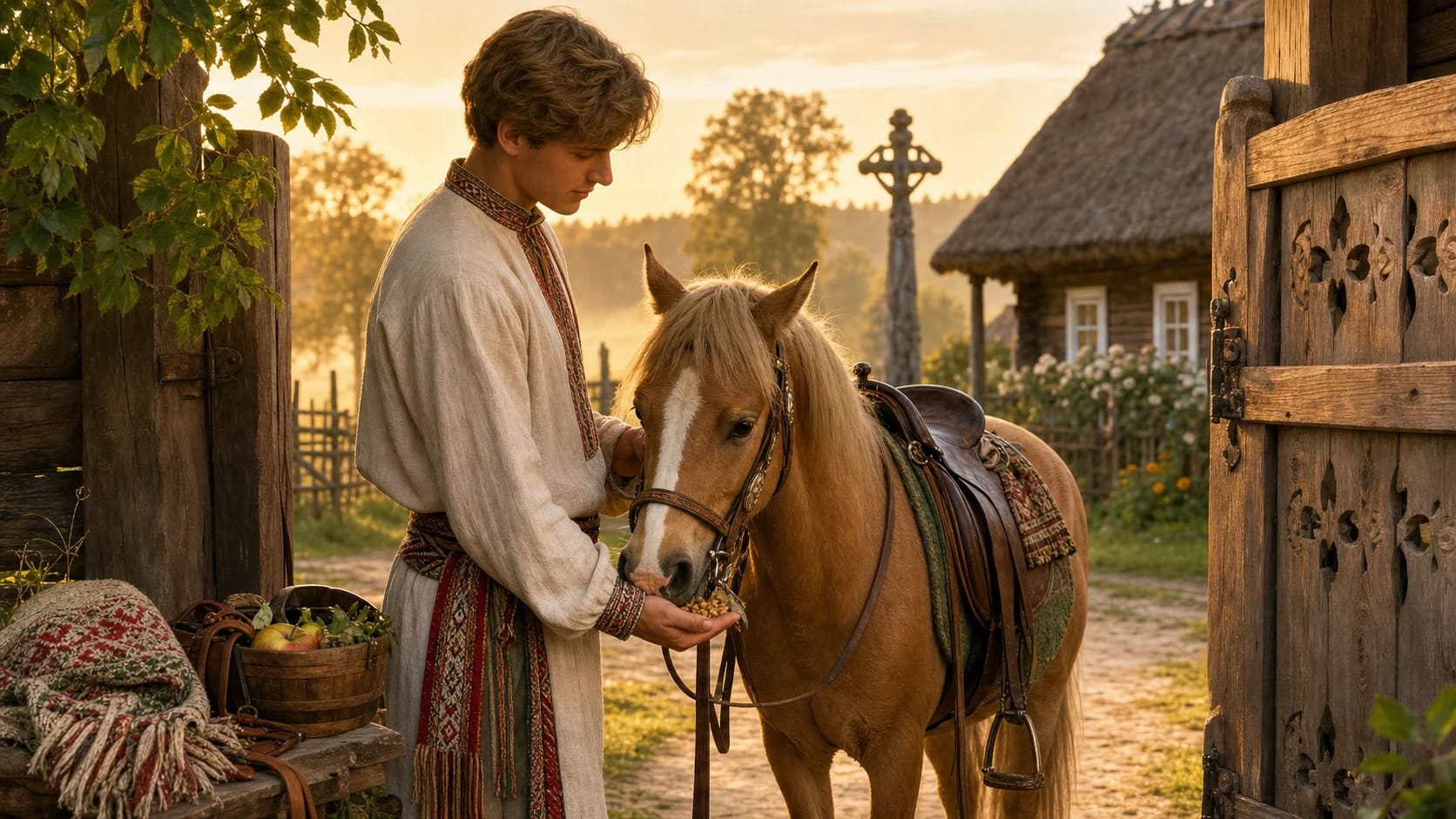
I Fed My Little Horse: song interpretation
The horse here is a sign of a young man's status. It is not merely fed, but adorned with golden hobbles and silk covers, so it becomes ready for public display. There is pride in the song, but it is not aggressive: the young man shows that he can care for a horse and set out on the road.
The Nemunas and Neris give the song a wider, almost epic scale. The rivers are not only crossed; they become a boundary between home and journey, between childhood at the father's house and independent life. For that reason the little horse may signify readiness for courtship as well as military or travel maturity.
I Fed My Little Horse: symbols and phrases
- Little horse
- A sign of the young man's honor, mobility, and readiness. A well-kept horse shows the value of both family and rider.
- Golden hobbles
- A luxurious, idealized horse adornment. It emphasizes not everyday work but solemn departure.
- Nemunas and Neris
- Great river boundaries marking the road away from the father's home and into a wider world.
- Level meadow
- An open riding space where the young man can display his horse and readiness.
I Fed My Little Horse: song history
In Juška's collection this song belongs to the large family of horse songs. In the printed variant it is given with two-part repetition, while digital LMTA records also show the close title variant "Išsišėriau sau žirgelį." Such shifts in form are common: a singer may begin with "nusišėriau," "išsišėriau," "I grew up at my father's," or another form of the same poetic formula.
The core of the song is not only keeping a horse, but preparing for travel. Level meadows, the Nemunas, and the Neris expand the home space into a road across waters. The song can therefore be sung as a text of youth, riding, departure, or courtship preparation.
I Fed My Little Horse: sources
I Fed My Little Horse: frequently asked questions
Why does the song begin with feeding the horse?
Feeding shows long preparation. The young man not only owns a horse but cares for it himself, creating the image of a ready rider.
Is this a love song or a war song?
It can fit either context. The text does not speak directly of war or courtship, but the prepared horse and river crossing suggest departure.
What is the difference between "nusišėriau" and "išsišėriau"?
They are close variant opening verbs. In folk song, such dialectal or performer-chosen differences do not change the central motif.
Why is the horse small but beautiful?
The song values not only strength but elegance and the rider's pride. A small but beautiful horse suits a lyrical rather than heroic tone.
Why are the Nemunas and Neris mentioned?
They widen the song's space and make departure a serious passage. Rivers in folk songs often mark boundaries that must be crossed.
Is Juška's text the only version?
No. ePaveldas records and other collections show a family of variants, but Juška's text is a convenient full printed base.