
Gossip lyrics and meaning
Aš anksti kėliau,
Visus pasėjau
Žaliuosius meironačius.
Aš retai sėjau,
Jie tankiai dygo
Ir gražiai pumpuravo.
Iš lapelių
Vainiką pyniau,
Daviau kiemo mergatėms.
Iš pumpurėlių
Kvietkelių skyniaus,
Daviau kiemo bernatiems.
Einu per kiemą,
Girdžiu per sieną,
Apkalb mudu žmonelės.
Ei, nebok nieką,
Brangi mergyte,
Mink žodelius po kojomis.
Padžius medeliai,
Nukris lapeliai,
Paliaus mudu apkalbėti.
View illustration
Gossip: song interpretation
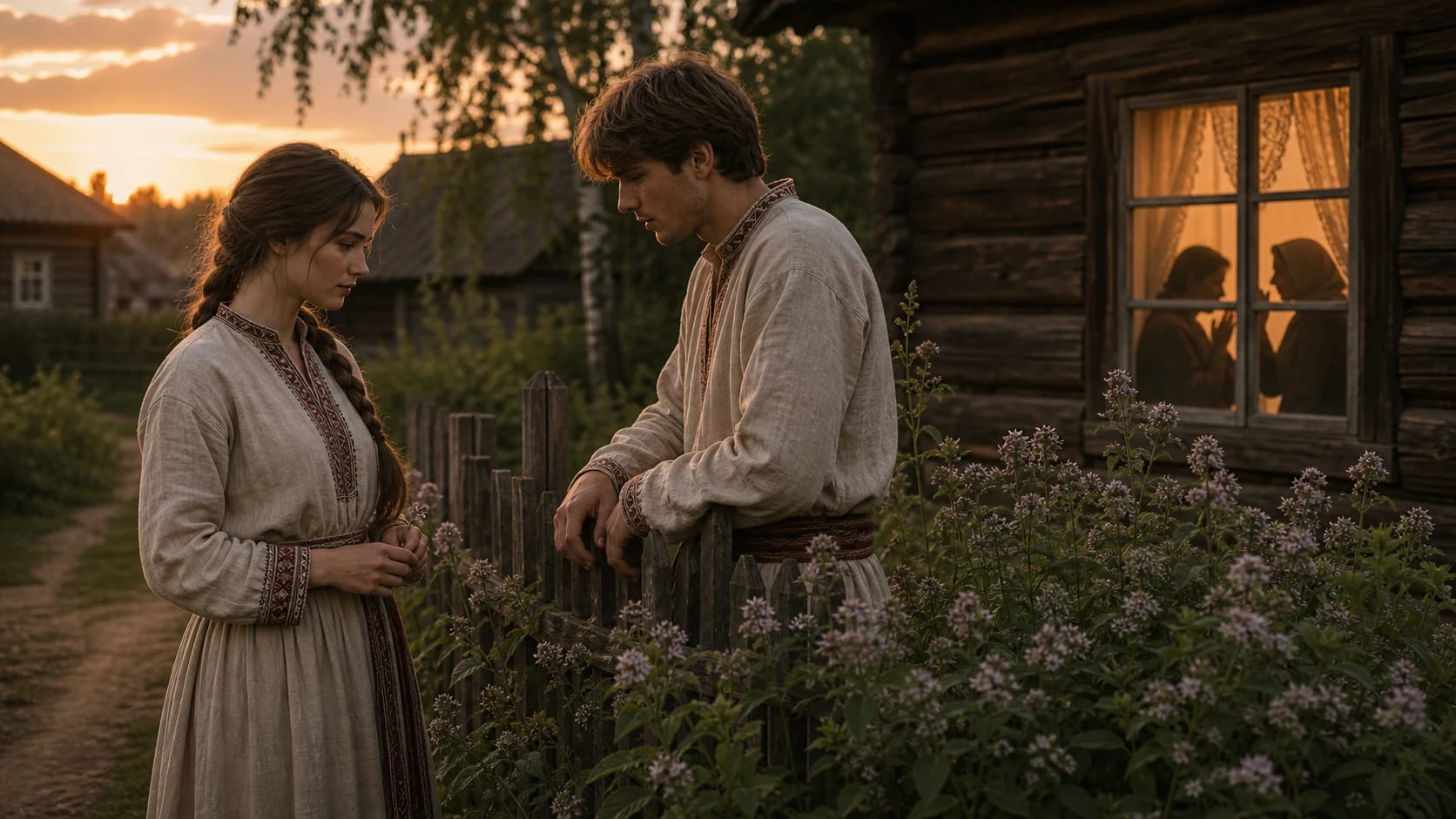
The beginning of the song looks like a scene of growth and beauty: marjoram is sown, a wreath is woven, and flowers are shared. But in the middle, gossip is heard. Beauty and gossip go together here because young relationships in a village community are always visible.
The answer, "tread the words under your feet," is powerful. It urges the beloved not to yield to talk, but simply to step over it. The song believes gossip is temporary like leaves on trees: they will dry, fall, and the speakers will fall silent.
Gossip: symbols and phrases
- Marjoram
- Fragrant garden plants that show a tended space of youth and love.
- Wreath
- A sign of a young woman's beauty, honor, and recognition within the community.
- Gossip behind the wall
- The watching village community. It shows that the young pair is not fully private.
- Falling leaves
- An image of temporary talk. Gossip will pass like a season.
Gossip: song history
Rėza's "Gossip" is a song from Lithuania Minor about speech, gossip, and the relationship of young people under the eyes of the community. The title itself is connected with speaking, rumor, and what is said about a pair behind the wall.
This title is not as common in the archives as broad formula-type songs, so Rėza's printed text is the main basis here. The text shows the community as an environment that hears and judges: love does not happen in private silence, but in the yard, behind walls, among people's words.
Gossip: sources
Gossip: frequently asked questions
What does the title "Paskalba" mean?
It is connected with speech, gossip, or what is said about others. In the song, this appears directly in the people's talk.
Why is marjoram sown at the beginning?
The garden plants create a space of youth and beauty. They contrast with the gossip that appears later.
Who are mergatės and bernačiai?
They are Lithuania Minor and older language forms for girls and young men.
Is this song about love?
Yes, but its center is not only love. It is love in the eyes of the community, when other people comment on it.
What does "tread the words under your feet" mean?
It is an instruction to ignore gossip and step over it. Words are imagined as something that can be trampled.
Why is this song rarer in modern recordings?
Some of Rėza's texts survived more strongly in the printed tradition than in audio archives. That does not make the text unimportant.